


In professional cycling, every gram counts. For a rider attacking the slopes of Mont Ventoux or Alpe d'Huez, the weight of his machine determines his weight/power ratio, a metric that separates the winners from the rest of the peloton. However, since the year 2000, a technical barrier has forced engineers: the 6.8 kg limit. This threshold, imposed by the Union Cycliste Internationale (UCI), defines the minimum mass that every bike must meet in order to start a stage in the Tour de France.
Contents
The 6.8 kg rule: between safety and sport equity
The UCI regulation on the minimum weight of bicycles meets a technical need which has emerged with the rise of carbon fibre. In the late 1990s, the race to lightness became dangerous. Experimental frames, too thin, risked breaking during descents at more than 90 km/h or on paved areas.
A barrier for the safety of riders
The primary objective of this limit is to ensure the structural integrity of machinery. By fixing a floor weight, the UCI requires manufacturers to maintain a thickness of material sufficient to absorb shocks and withstand extreme mechanical stresses. If the current moulding technologies would permit the design of frames below 5 kg, the legislator maintains this threshold to prevent the quest for performance from sacrificing reliability of equipment.
Fairness between professional teams
The regulatory weight is also used as levelling. Without this limit, colossal budget teams could invest in exotic materials or ultra-cost manufacturing processes, creating an insurmountable technological gap for small training. With 6.8 kg, most of the brands reach the same standard, moving the fight on the groundAerodynamics and rigidity.
Historical evolution: from steel bike to carbon jewel
The bike used by Maurice Garin during the first Tour de France in 1903 did nothing in common with the current mounts. At the time, the priority was robustness to face roads that looked like dirt roads.
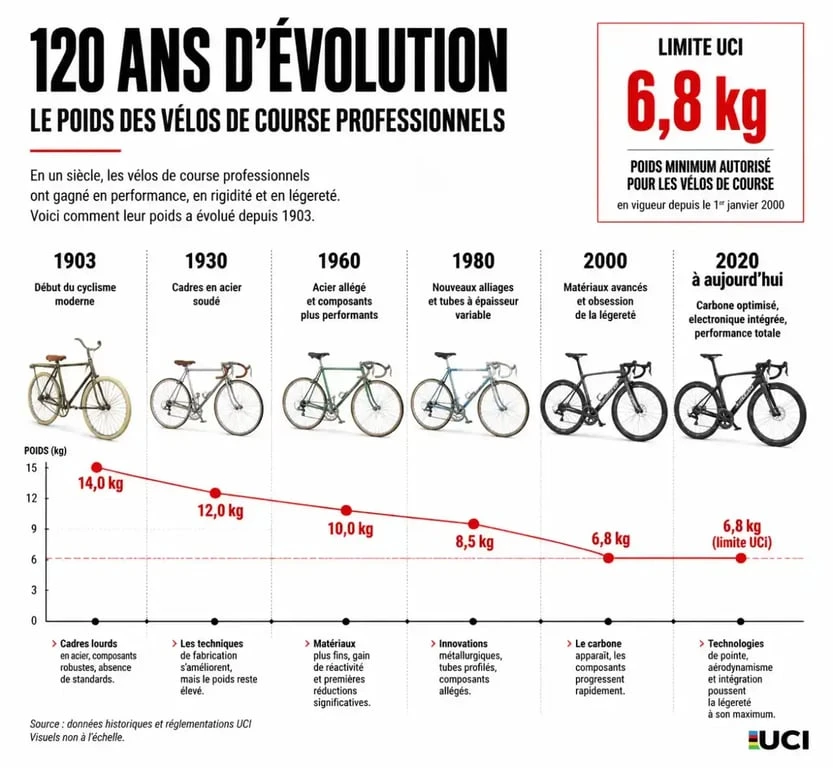
| Age | Average weight of bike | Dominating materials |
|---|---|---|
| 1903 – 1920 | 15 kg – 18 kg | Heavy steel, wood |
| 1930 – 1950 | 11 kg – 13 kg | Lightened steel, aluminium |
| 1960 – 1980 | 9 kg – 10.5 kg | High-end steel |
| 1990 – 2000 | 7.5 kg – 8.5 kg | Aluminium, titanium, carbon |
| Since 2000 | 6.8 kg (UCI limit) | Monohull carbon fibre |
In the 1970s, a 9 kg bike was a feat. The mechanics then drilled the components, such as brake levers or saddle rods, to gain a few grams during a craft practice called « dillium ». Today, the challenge is the opposite: engineers sometimes add lets in the saddle tube to prevent the bike from falling below the 6.8 kg mark.
How do engineers optimize each component?
Reaching the minimum weight while integrating modern technologies such as disc brakes and electronic transmissions is a constant challenge. Each piece is screened to meet the authorized quota.
The frame and the fork: the heart of the system
A modern high performance frame typically weighs between 700 and 850 grams. To achieve this result, manufacturers use carbon sheets of various densities, precisely oriented to offer stiffness at the pedal housing while maintaining some flexibility for comfort. It is a high-precision work where the slightest air bubble in the resin can weaken the structure.
The impact of disc braking and electronics
The adoption of disc brakes on the Tour de France added about 300 to 500 grams compared to the old skate brakes. The batteries and motors of electronic derailers also weigh up the whole. To compensate, manufacturers have optimized the other peripherals: integrated hangers, ultra-light saddles and hose wheels whose rims sometimes weigh less than 300 grams.
The choice of wheels is a science. On the plain, high rims are preferred, heavier but more aerodynamic. In the high mountains, we go back to low rims, because every gram in rotation costs a lot of energy when re-launching. The mechanic must anticipate the stage profile to adjust the equipment, knowing that a bike that is too light at the start causes a immediate disqualification during check-in.
Technical inspection: how does ICU check the weight?
The UCI carries out rigorous, random checks at the start of the stages and systematically for the winner and the leaders of the rankings at the finish. The official balance is fair.
If a bicycle is weighed at 6,790 kg, it shall be declared non-compliant. To avoid this misadventure, mechanics provide a safety margin of about 50 to 100 grams. They take into account the accumulated dust, the sweating of the rider who soaks up the guidoline, or the addition of GPS sensors and on-board cameras, recorded in the total weight during weighing.
Professional bikes vs commercial bikes: who is the lightest?
It is paradoxical to see that a wealthy amateur cyclist can legally ride a bike lighter than a professional. The catalogues of the major brands offer models « excluding weight » sometimes coming down to 5.5 kg or 6 kg.
The price of a Tour de France bike varies between 10 000 € and 15,000 €, mainly due to research and development. Unlike mainstream models, pro bikes are designed for an intense season and undergo daily checks. Finally, aerodynamics now prevails over absolute lightness: a very profiled 6.8 kg bike is often faster than a 6 kg less aerodynamic bike on most terrains.
The weight of a Tour de France bike remains a fragile balance between regulatory constraints and technological advances. While the 6.8 kg limit seems dated to some, it remains the guarantee of increased safety and a show where the athlete remains the decisive factor.
Updated on 23 June 2026