
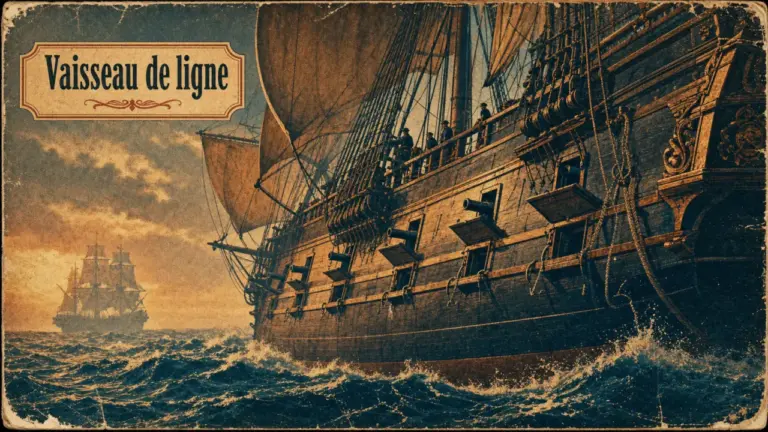
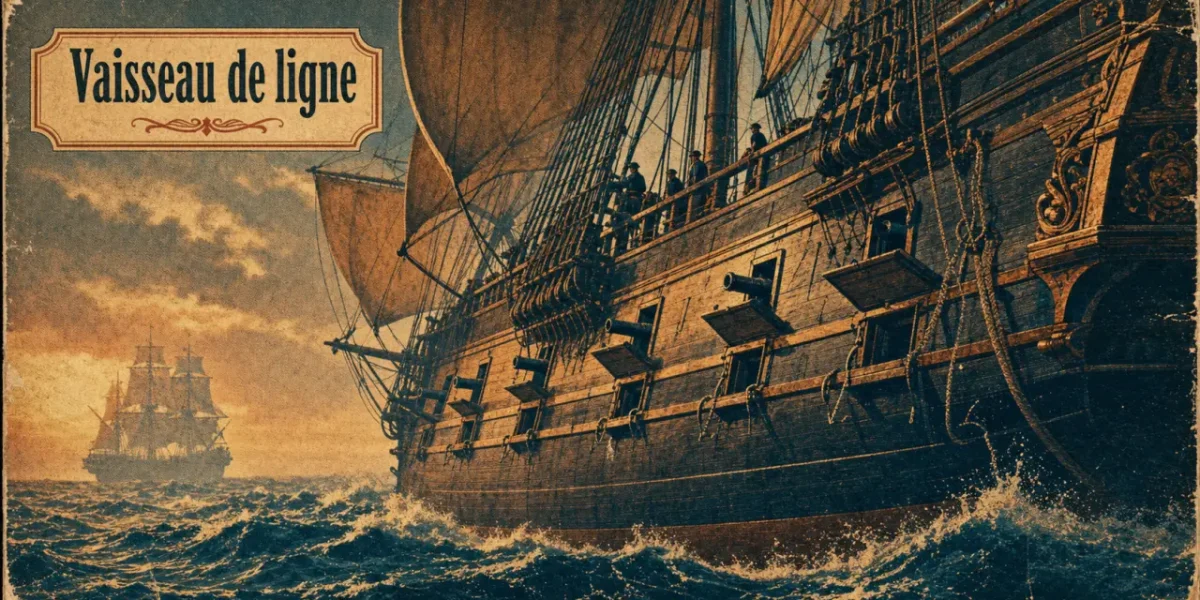
A former sailing warship is a wind powered military vessel designed to combat, escort, transport troops or control a sea route. Behind this expression are several families of ships, such as the Lineship, the frigate, the corvette, the nave, the Boiler, Galion Or the brigantine. The right term depends mainly on the time, size, rigging and tactical role.
Contents
Identify the right type of ship according to its use
In maritime history, not all ships armed with sails served the same purpose. Some formed the battle line, others patrolled, carried messages, or quickly attacked enemy convoys. To understand vocabulary, it is therefore necessary to start from the function of the building rather than from its sole silhouette.
Quiz : Sailing warships
Final score: /6
The ship: the firepower at sea
The ship, often referred to as a line ship, is the most imposing image of the sailing warship. His vocation was to hold his place in an organized fleet and exchange cannon edges with the enemy. Its reinforced hull, artillery bridges and complex rigging made it a military machine as much as a naval carpentry feat.
This type of building was less designed for pure speed than for resistance, stability and fire power. In a naval battle, he had to manoeuvre in formation, present his armed flank and withstand the shocks. It is the emblematic ship of the great European marines of the sailing era.
The frigate: fast, armed and versatile
The frigate was more flexible. Lighter than a lineship, she could recognize a fleet, escort a convoy, chase a privateer or transmit orders. Its value came from its balance, armed enough to fight, fast enough to choose confrontation or avoid.
Hermione is one of the best known examples of the general public. It recalls the strategic role of these ships capable of crossing the Atlantic, carrying news, men and sometimes considerable diplomatic issues. The frigate embodies less the massive duel than naval mobility.
Galiote, nave, galion: words related to epochs
The naf refers to older ships, often associated with the Middle Ages and the beginnings of organized maritime warfare. The GalionHe evokes the great crossings, colonial empires, precious cargoes and escort fighting. The Boiler is a more variable term depending on periods and countries: it can refer to a small armed building, sometimes used in coastal warfare or for rapid missions.
These names are not always interchangeable. They belong to different naval traditions, and their meaning can evolve according to languages. Therefore, in a set of letters or a historical text, the number of letters and context are often as important as definition.
Characteristics of a sailing warship
A sailed military building first recognizes its rigging. This set of masts, sails and ropes captures the wind and guides the ship. The hull must carry artillery, resist the sea and absorb the stresses of combat. Naval armament, finally, determines the offensive function of the vessel.
Batteries and sails: the engine of the building
Large vessels generally had several masts, including the Missing mast At the front, on big mast in the centre and the mast Back. Each mast wore sails suitable for wind and manoeuvring. There are also front sails such as foc, trinquette or genoese, as well as more specialized sails such as the tormentor, useful in bad weather.
Combat performance depended directly on this architecture. A vessel capable of properly turning, maintaining speed or holding a position on the wind could gain a decisive advantage. The sail was not only a means of propulsion, it was part of tactics.
To imagine the complexity of such a building, think of a rope between two points. If the tension is poorly distributed, all the balance is distorted. On board, each manoeuvre operated in the same way, but on the scale of a mast forest. The ropes were not only used to hold the sails, they transmitted forces, adjusted angles, absorbed the blows of the wind and allowed the crew to turn a gust into a controlled movement.
Case, bridges and cannons: military anatomy
The hull of a warship had to bear the weight of guns, ammunition, food and crew. The sabords were able to fire from the flanks. The bridges organized life on board and the power of fire: the more important the building was, the more it could embark artillery and support a prolonged combat.
This solidity, however, had a price. A highly armed vessel could be less agile, more expensive to maintain and more demanding in men. Conversely, a frigate or corvette sacrificed part of the gross power to gain speed, autonomy and response capacity.
Table of main names to be known
To quickly compare the terms, the Table below brings together the most useful names. It does not replace a detailed historical study, but it helps to distinguish large families and find the right word in a literature search, a duty or a crossword grid. Classification by number of letters is also convenient when you need to go fast.
| Name | General role | Useful index |
|---|---|---|
| Vessel | Heavy combat in fleet | Often associated with the battle line |
| Fragate | Recognition, escort, rapid combat | More mobile than a ship |
| Corvette | Patrol, liaison, light escort | Smaller and handy building |
| Galion | Armed transport and ocean war | Summons the major maritime routes |
| Nef | Former transport or warship | Common term for medieval periods |
| Galiote | Small building armed according to custom | Interesting word for old definitions |
| Brigantin | Fast sailing ship | Often associated with race and light missions |
The HMS Victory is often cited as the oldest remaining warship. Its name comes back frequently when it comes to the golden age of large sailing vessels and the imagination of naval battles. Next to him, Hermione It has a strong place in French-speaking memory, as it makes the functioning of a frigate and life on board more tangible.
Why these ships marked maritime history
The old sailing warships have transformed the way the seas are controlled. Before steam and metal hulls, the power of a state was also measured by its ability to build, arm and maintain buildings capable of crossing the oceans. Ports, arsenals, trade routes and combat zones formed a single strategic system.
Sailing as an instrument of power
Wind propulsion allowed long distances to be travelled without dependent on on on-board fuel. On the other hand, it required a fine knowledge of winds, currents and seasons. The captains had to deal with the weather as much as with the enemy. This constraint explains why the manoeuvre was as important as artillery.
A ship could win a fight by obtaining a better position, cutting the opposite route or protecting a convoy. The naval war was not only a cannon affair: it was a game of anticipation, collective discipline and wind reading.
From battle to popular memory
These buildings still fascinate because they combine technical, adventure and danger. Their silhouette imposes an immediate emotion: high masts, superimposed sails, armed bridges, many crews. In novels, museums, re-enactments and discussions of enthusiasts, they embody a time when the sea was both a battlefield, a trade route and a space for exploration.
Useful solutions for crosswords and letter sets
The search can also start from a blockage in a grid. The specialized sites sometimes offer many entries: for example, lists with 20 replies proposed and classification by 3, 4, 5, 6, 7, 8 or 9 letters. To go quickly, start from the number of boxes, then check whether the definition refers to an old ship, an armed vessel, a type of sail or a specific time.
| Number of letters | Possible routes | To be checked in the definition |
|---|---|---|
| 3 | Nef | Ancient ship, often medieval |
| 6 | Galion | Large ship armed with ocean roads |
| 7 | Fragate | Rapid War Building |
| 8 | Galiote | Small old ship, sometimes armed |
| 8 | Vessel | Large war building |
| 9 | Brigantin | Fast-sail vessel |
If the grid indicates only "old ship", naf or Galion may be appropriate. If it insists on war, armament or the fleet, think about ship or frigate. The simplest is to cross three clues: length of word, suggested period and military function.
Updated on 14 July 2026