If you are looking for a concrete method to lose weight by cardio, let me share what twenty years of training have really learned: it is regularity and pleasure that make the difference, not miracle protocols or suffering at all costs. No matter where you are, aim 45 minutes, twice a week, it is already relevant to initiate the essential process being to adjust the intensity according to your constraints, with the look turned towards the actual energy expenditure.
Between memories lived on the Rhône and tricks gleaned to thwart false commercial promises, my goal is to guide you step by step, without neglecting safety or motivation: here, we sort together, without jargon or judgment, so that each session is a solid step towards your personal goals.
Summary of key points
- ✅ Aim for 45 minutes of cardio, twice a week, adapting intensity to your abilities.
- ✅ Regularity and pleasure take precedence over extreme methods or miracle solutions.
- ✅ The essential for weight loss is the total energy expenditure, not just the type of exercise.
Contents
Cardio and weight loss: the truths that matter to really lose weight
You hope to understand in practice how cardio works on weight loss, without the pitfalls of false promises or endless routines? Here's what we can keep straight: it's above all the total amount of energy spent as you work on the balance – and cardio, well chosen, plays a central role. To start seeing changes, better aim 300 to 600 calories burned per hour (depending on the intensity), organising at least 2 sessions of 45 minutes per week when you start.
Another point: this is not only the type of exercise, but also the intensity and especially the regularity that make all the difference... no method works long-term without a minimum attention to diet.
At this point, a question often comes back: should we prefer an energetic HIIT or bet on regular footing? Can we get out without a sophisticated treadmill? And how to keep the distance without blowing? This guide is based on the most frequently encountered questions in coaching and in the field, separating the proven facts from the received ideas seen on the Internet.
Why does cardio make weight loss easier?
Whether it's running, cycling, rowing or walking fast, cardio pushes your body to tap into its reserves to get the energy needed – first glycogen (sugars), then gradually lipids (fats), as the effort continues. We notice that the longer the effort stretches, the more the use of fat increases... but beware of simplistic shortcuts.
In practice, the essential is: balance between energy spent and calories consumed which will condition weight loss.
Moreover, this mechanism has demonstrated its effectiveness on a host of practitioners, from sedentary motivation to amateur rowing. A well thought-out cardio session burns on average 300 to 600 calories per hour (depending on your morphology and intensity). For example, a peaceful rowing session on the Rhône regularly costs me 400 calories, without the need for sophisticated equipment or expert level.
Fat Oxidation: the real issue behind weight loss
You've probably heard of the famous "burn-fat zone": it's simply a range of intensity, usually around the 60-70% of your maximum heart rate, where the body favours the use of fat (especially if the effort lasts). But this is also why we should not focus solely on this area to hope to lose weight! Recent studies show that total energy expenditure remains the main criterion...
A modulated effort (alternating intensities) is sometimes just as relevant, if not more, to those who lack time.
Coach question: Have you ever tried to walk 10 km in one shot? Even with a low intensity, this kind of challenge seriously solicits your reservations (of patience too, it is true).
HIIT or Cardio Classic: what to choose according to your profile?
You're tired of running an hour in a row? High Intensity Interval Training promises accelerated fat burning in a short time. But is this method suitable for each profile, or is this a mode that is well promoted on networks?
Let's look at the essential, tested and validated "home" differences (there's always a rower or a chronometer hanging around my living room):
- HIIT: short sessions (15 to 30 min), alternating sustained effort and recovery, requires a minimum of physical condition, demonstrated efficiency for fat loss and cardio improvement in less time.
- Cardio in moderate rhythm: continuous effort (45 min to 1 h), suitable for beginners or those who prefer to avoid intensity, less risky for joints.
- Low intensity cardio: particularly suitable for recovery, situations of overweight or just to regain sensations without pressure or discouragement.
Some professionals believe that HIIT can achieve significant results in only 8 to 12 weeks and can result in fat loss equivalent to that of a classic program... with twice as much training time! But keep in mind the power of "less but regularly": two sessions of 45 minutes per week usually have remarkable effects over the medium term.
Choose according to your level and personal context
If you're starting or your weight is stopping you, it's best to choose a moderate or low intensity cardio – even in a quiet split. The HIIT, for its part, is more suitable for those already a little active (unless you are accompanied). A trainer said that her new rowers quickly found themselves sprinting clumsyly, especially when the motivation (or forgotten taste) pushes them to give everything.
Another point not to lose sight of: pleasure and constancy clearly prevail over forced intensity. It is not a race against time, but a personal journey towards a better form.
What practical protocols should be preferred to start?
No need to lock up in the gym or multiply gadgets to get started. Organizing effective sessions at home, in the open air or in the room remains accessible – essential, this is what nourishes your confidence. Some note that a lunch break is enough to fit a cardio malignant session, even in a busy schedule.
Accessible home protocols: examples and numerical benchmarks
Let's look in more detail at the tested and proven formats, perfect for starting without specific hardware:
- Circuit Training Alternative: chain 5 to 10 different exercises without pause (squats, slots, jumping-jacks, mountain slimbers, etc.).
- 15 to 20 repetitions per exercise, recovery from 3 to 5 min between each circuit, repeat 3 to 4 times per session to target approximately 45 minutes training.
- Adapt the intensity level: look to reach 60% of your FCM (maximum heart rate, easily computable via an online simulator).
A typical session at home, repeated twice a week, allows to burn between 600 and 900 calories total. For those in need of time, the fraction on site is effective (20 seconds of effort, 20 rest, 10 movements to be chained). Sometimes a user improvises with what he finds under his hand – a solid chair, stairs, the essential being the energy deployed.
Rhetorical question: do you think you don't have "no material"? We bet that by looking well, stairs and furniture do the job perfectly. Ready to try?
Security, motivation and sustainable success
Impossible to ignore the motivation in this adventure... but safety remains the priority for all, especially if you haven't moved in a long time. It is often found that a re-established pleasure and regularity are real accelerators of progress suffering and austerity, they discourage much more than they motivate.
Tips to avoid injury and discouragement
It's best to have your sport project checked by a doctor, especially in case of cardiovascular history or if you really want to climb in intensity (it's a systematic precaution in my rowing groups before each season).
- Adopt a gradual climb: start with a moderate session twice a week, then adjust to your feeling.
- Pay attention to body signals: unusual shortness of breath, joint pain or excessive fatigue should alert you.
- Think about hydration and recovery: a glass of water and 5 minutes walk after each session are the strict minimum.
- Don't lose sight of the notion of pleasure: test different sports (bike, swimming, rowing, domestic circuit) and keep the one that gives you a real smile, at least once a week.
Last but not least, sustainable success depends on pleasure and real flexibility in the organization. It is not uncommon to see young people like Emma, eager every weekend to go back on the water "just to try to pass in front of Dad..." this kind of envy often makes the real difference over time.
To understand the actual cardio results of 1 hour per day, time and advice adapted, it is essential to prioritize regular sessions adapted to your level.
To maximize your cardio sessions and effectively target fat melting, discover powerful abdominal fat burners to target the belly and refine the silhouette.
To maximize your cardio sessions while effectively targeting fat loss, discover the weight loss training circuit: the simple and accessible method to burn fat.
FAQs, tools and simulators for regular progress
Cardio, applied to weight loss, also uses practical tools: heart rate simulators, FAQ targeted to common difficulties, online scalable programs. Another point: dietitians, coaches, video formats or podcasts are increasingly present to accompany you on this journey.
Recurrent issues and relevant resources
To move forward without losing sight of the objective, here are some answers to the most common questions:
- What type of cardio to reduce abdominal fat?: all cardio formats help reduce overall fat HIIT is faster, but a moderate pace is regularly easier to follow over time.
- How much cardio time a week?: bet on 45 minutes, twice a week When starting, gradually adjust according to your progress.
- Is the effectiveness of HIIT really superior?For those without medical contraindications, already active, this is validated but the high intensity, more risky for beginners, requires reflection and caution.
- Is cardio essential for weight loss?: No, it is not an absolute necessity, but it clearly accelerates loss when it accompanies a reasoned diet.
Do you want to calculate your FCM (maximum heart rate) or develop a suitable program? Many simulators are available online: it's worth testing them, or asking for the opinion of a local sports coach (on the daviron groups, this request is frequent: "Camille, do you help for my personal plan?").
Human Accompaniment and Testimonials: The Spring of the Click
We never emphasize it enough: without accompaniment, without feedback, without some anecdotes glided at the turn of a session, success becomes to what it quickly seems more complicated. Human accompaniment remains the main spring for crossing the course, far ahead of the "key in hand" programs gleaned on the Internet.
Field returns and tailor-made advice
I've come across as many unexpected breaks as there are significant successes: what makes the difference is exchange and support. Lucas, 14, today, remembers that his first footing, he did it "to please me"... then, after six months, he ran for himself (and for his basketball team).
If you hesitate to start or if a decrease in motivation threatens, surround yourself: self-help, video coaching, online testimonials or with a local professional, all this changes the situation. Some experts also mention that joining a group, planning with a coach or simply sharing your little progress every week makes a snowball.
- Choose to join a community, make an appointment with a professional, or set weekly milestones for your progress.
- Explore custom programs offered locally or via online specialists.
- Allow yourself the right to celebrate each stage: losing 1 kg weighs just as much as engulfing your first 5 km without interruption.
And if the weariness points... vary, adjust, improvise. In absolute terms, it is not pure technique that should guide your choices, but pleasure and regularity. The rowing man instilled that every rowing stroke counts, including the grey and chilly days on the Rhone (it's not always obvious, really).
Frequent mistakes and myths to remove with discernment
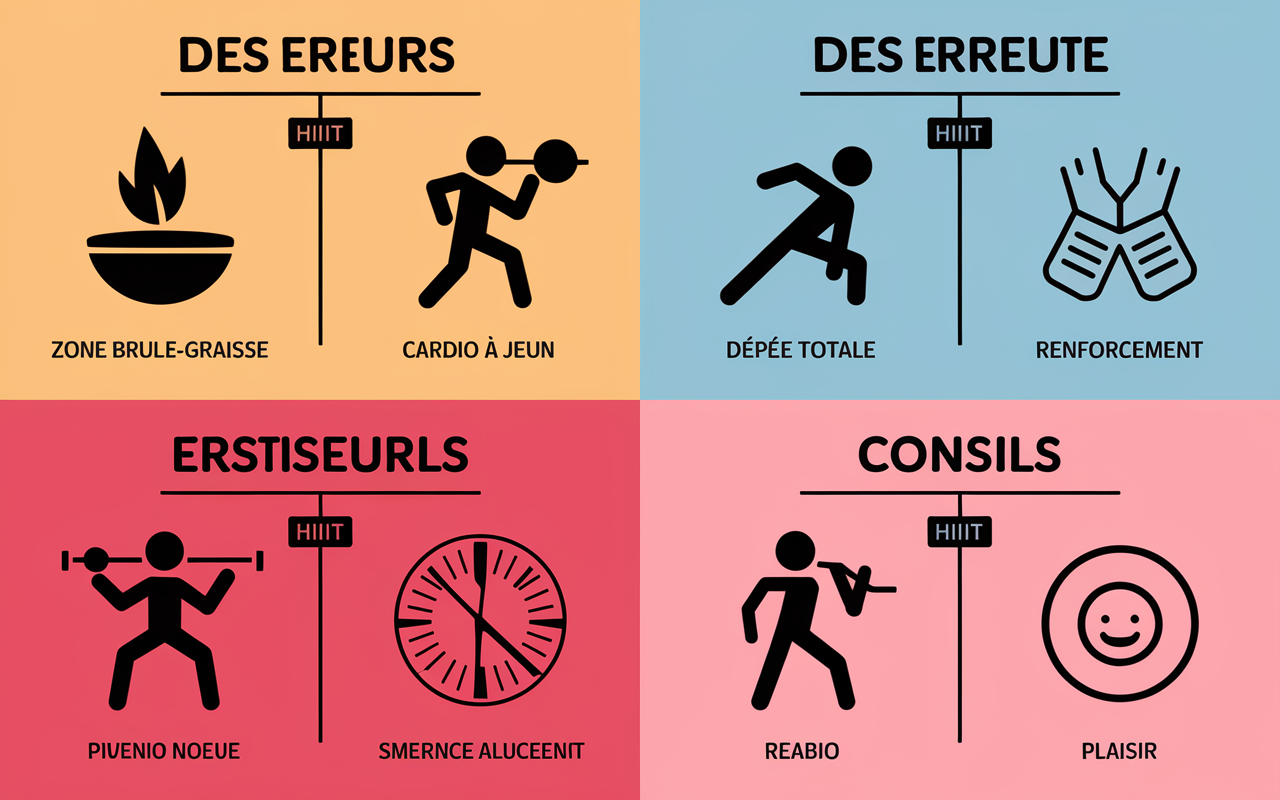
There are, among other things, regularly contradictory statements about cardio and weight loss: the "burn-fat zone" presented as l'eldorado, the extreme protocols "to melt quickly", a flood of information that discourages or causes injury due to lack of concrete benchmarks.
Demystification & Prevention Tips
To move forward in complete serenity, let us add some necessary precautions:
- The "burn-fat zone" is not a condition for weight loss: total expenditure remains fundamental.
- Doing fasting cardio doesn't necessarily accelerate loss: prefer to question your habits and shape before choosing.
- HIIT does not work miraculously: it requires technique and special attention to prevent injuries.
- Cardio alone is not enough: combine it systematically with muscle building and a balanced diet.
In concrete terms, nothing is written for good: adapt, try, adjust. Keep the fun at the center, the results will come as they come. One trainer recently mentioned that it is better to test, correct, and above all never compare with others.
If you're not interested in a fundamental question, or if you just want to talk about sport without taking your head off ... ask a coach or share your experience on a passionate forum (no need to be professional – far from it).
Updated on 21 March 2026