

For a short and quiet footing, running before eating can suit you if you support it well. For an intense or prolonged session, it is usually better to have eaten, leaving time to digest. The right choice therefore depends above all on your effort, the last meal and your digestive tolerance: fasting is neither indispensable for progress nor a guaranteed shortcut to lose weight.
Contents
Choose according to session, not only according to time
Running before lunch after having breakfast did not amount to running fasting at waking. In the first case, you have already received energy in the morning; in the second, you prolong the night fast. This distinction avoids putting all exits « before eating » in the same category.
Test your knowledge of running and feeding
Six questions to review key benchmarks. Choose a response at each step; corrections will be displayed on validation.
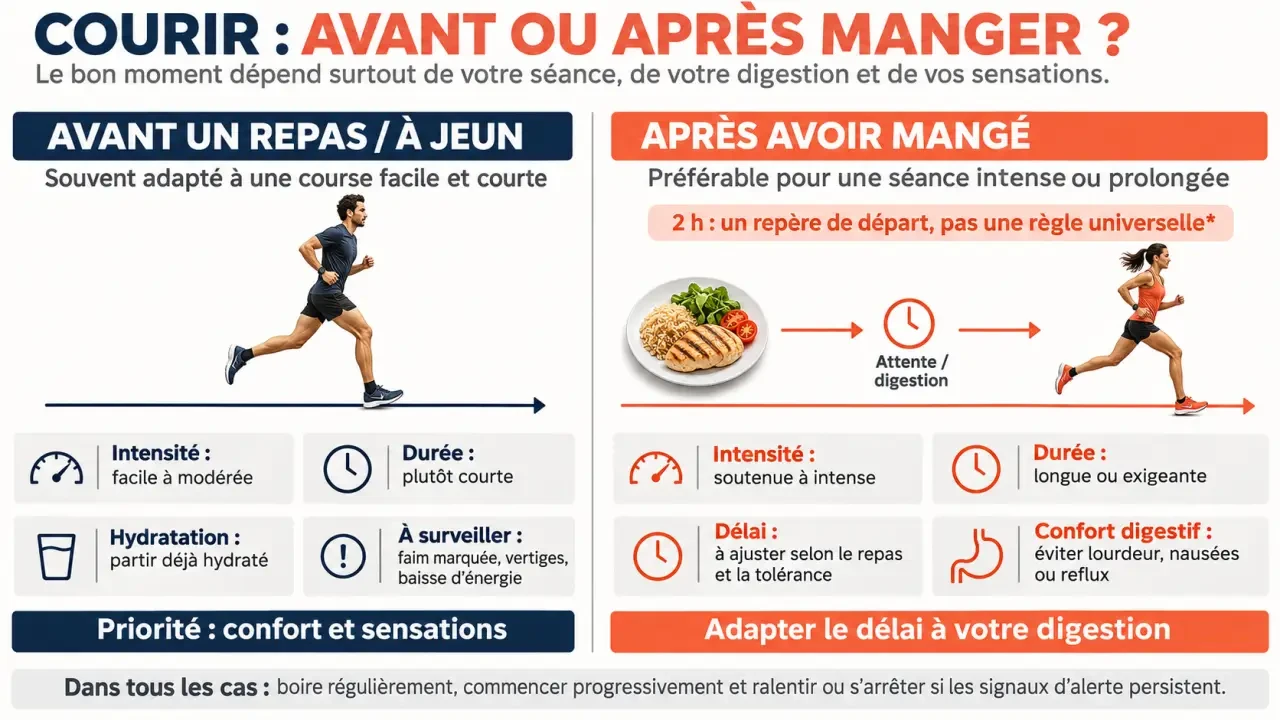
The more intense the effort, the more carbohydrate availability becomes. A footing at a pace that makes it easy to speak does not solicit reservations like a split session. For accelerations, ribs or a prolonged exit, eating upstream helps to support the effort, provided you do not leave the stomach full.
| Proposed session | Option to be preferred | Point of vigilance |
|---|---|---|
| Short and easy footing | Before or after eating according to your comfort | Do not insist if hunger or weakness appears |
| Split or rib | After a digested meal or a suitable snack | Avoid the hearty meal just before |
| Extended exit | Provide for inputs before and, if necessary, during | Anticipate rather than wait for exhaustion |
| Resuming the race | Leave without starvation, with a meal sufficiently far away | Do not combine new effort and first fasting experience |
Beyond 45 minutes, the question of energy intakes deserves more attention, especially if you are going to increase or fast. This marker is not a physiological boundary: it does not mean that you must always eat during any longer exit.
After a meal: leave room for digestion
Running causes shaking and changes the distribution of blood flow, especially when intensity increases. A still loaded stomach can then promote nausea, reflux, bloating or abdominal cramps. Eating before running is not the problem in itself: the quantity, composition and timing of the meal together.
Two hours: a starting point, not a guarantee
Solomon and Nike mention a delay of 2 hours between a meal and a race. Use it as an initial marker, then adjust it to your sensations. A hearty lunch, fat sauce or usually slow digestion may take longer. Conversely, a small snack does not necessarily require the same expectation as a full meal.
If you still feel a heaviness at the start, move the session or replace it with a walk. Moving more slowly can improve comfort, but it is not always enough to compensate for too recent a meal.
Foods that are familiar and easy to tolerate
Before a race, choose digested carbohydrates, in quantity adapted to your hunger: bread, rice, compote or ripe banana according to your habits. Very fat meals slow down gastric emptying; large portions of fiber can increase digestive disorders in some runners. It is not a question of removing these foods on a daily basis, but of better placing them around the sessions.
If you run at noon, a snack in the late morning can be more comfortable than a lunch swallowed just before departure. The main meal comes next. Also avoid drinking a large amount of water at once: prefer regular hydration.
Fasting: understand the energy used and the limits
After one night without eating, liver glycogen reserves decreased, but muscles are not necessarily « empty ». During the race, the body uses a mixture of carbohydrates and lipids, in proportions that vary notably with intensity and duration. Running fasting can increase the proportion of fat used during some easy efforts.
Burning more fat doesn't guarantee any more weight loss
The use of lipids during a session alone does not predict fat loss. This depends in particular on the energy balance over time, overall feeding and regular activity. If fasting leads you to shorten your outings or eat more then, it does not necessarily provide more.
For a goal of weight loss, therefore, prefer a sustainable organization, which allows you to run with pleasure and recover correctly. You don't need to be hungry for your session to be useful.
Test without turning footing into a test
If you are in good health and want to try, choose a short, easy and close exit. Drink when you wake up and carry a sweet food and a phone. Do not combine this first experience with an increase in distance or a quick session: it would make it difficult to identify what you really tolerate.
The key is to keep an exit door: imagine a loop that returns near you rather than a journey that keeps you away from it. You can return from the first signs of discomfort, without having to finish an imposed distance. This flexibility makes the test more prudent and avoids confusing perseverance and risk-taking.
Adapt routine and recognize alert signals
A beginner usually gains to stabilize first his pace, his schedules and his diet. A confirmed runner can experience more, but his experience does not protect him from a lack of energy. To prepare a competition, test meals and snacks during training: the day of the event is not the time to change your habits.
To identify your best functioning, note during a few trips the last meal, interval before departure, intensity and digestive sensations. Then change one parameter at a time. In this way, you will distinguish a meal that is too heavy with too fast a look or too late to start after eating.
- Before: check your hunger, hydration, and the type of session you plan.
- During: slow down or stop in case of dizziness, tremor, unusual sweat or marked weakness.
- After: Drink and plan a meal combining carbohydrates and proteins to support recovery.
These symptoms may evoke hypoglycaemia, without allowing for diagnosis alone. Stop the effort, make yourself safe and, if you are conscious and able to swallow, take sugar. Confusion, loss of consciousness or persistent symptoms require urgent medical assistance; give nothing to swallow to an unconscious person.
In case of diabetes, treatment that may lower blood sugar, repeated malaise or history of eating disorders, ask for medical advice before running fasting. The best time is the one that allows you to run regularly, with enough energy and without recurring discomfort.
Updated on 3 November 2026