Kayak fishing seduces herdiscretion, its freedom of movement and direct contact with water. It makes it possible to approach an inaccessible border from the shore, to drift on a breakout, to prospect a shoal or to walk along a reed almost noise-free. However, this simplicity requires preparation, as kayaking is neither a boat nor a motorized boat, and every choice of equipment, weather or technique affects safety as well as fishing pleasure.
Contents
Why kayaking changes the way you fish
The main interest of fishing kayaking is itssilent mobility. At sea as well as in fresh water, it allows to explore sparsely used areas, adjust its drift to wind or current and fish as close as possible to fish activity. Where a boat sometimes imposes heavy logistics, kayaking remains more accessible: easier transport, quick watering, zero consumption and feeling of immediate autonomy.
However, this freedom has a counterpart: the fisherman is also the pilot. It is necessary to manage the paddle or pedal, the drift, the cane, the lure, the exhaust and the environment. This is what makes practice stimulating, but also demanding. A successful exit often begins before the arrival at the waterfront, with the reading of the weather, the choice of a reasonable area and a clear organization of equipment within reach.
Sea or fresh water: two atmospheres, two vigilances
At sea, kayak fishing is more vulnerable to tides, wind, clapper, currents and water traffic. Coastal areas can be very productive, especially around rockheads, parks, sandy edges or plateaus, but they requiresafety marginpermanent. In freshwater, the constraints are different: submerged obstacles, varying levels, shared navigation, local regulation and sometimes limited access. In both cases, it is best to start near the edge, on a known area, in stable weather and with a short route.
Choose a kayak and equipment that remain simple to manage
The good kayak is not necessarily the most equipped, but the one you control easily. For starters, stability, buoyancy, ease of boarding and storage space count more than pure speed. A model that is too long or too heavy can become difficult to carry, while too narrow a kayak will require more balance when throwing, animation or running out.
| Element | To be preferred | Why it's useful |
|---|---|---|
| Kayak | Stable, suitable for the middle, with accessible storage | Keep control during fishing and manoeuvres |
| Canne | Short to medium, handy sitting | Launch, animate and fight smoothly on board |
| Lures | Soft lure, hard lure, surface according to depth | Adapt quickly to the positions encountered |
| Security | Jacket, VHF according to zone, waterproof bag, line arrester | Respond to falling, drifting or changing weather |
A storage designed like a cockpit
On board, every move counts. The most used lures must remain accessible without dangerously bending. The phone, papers, a hot layer and keys are placed in a waterproof bag. A clamp, a line cutter and a small box of leaded heads can be attached or stored in a central area. The aim is not to take everything away, but to avoid unnecessary movements that unbalance the kayak.
Think of kayaking as a compact workstation where the line, paddle, exhaust, boxes and even legs must travel smoothly. If a chain holder blocks the paddle grip, if a box slides under the feet or if the anchor mixes with the wire, the outlet loses fluidity and safety. Before you fish, sit on board ashore or at the edge of the water and simulate the gestures: take a decoy, change mounting, grab the exhaust, store the cane, take the paddle. This test often reveals real organizational flaws.
Effective techniques from a kayak
Kayak fishing promotes active and accurate techniques. The fisherman moves slowly, drifts naturally and can cover an area with method. The lures are particularly suitable, as they allow different layers of water to be explored without heavy handling. The choice depends mainly on the depth, current, season and species sought.
Soft lures, hard lures and texan mounting
The soft lure on leaded head remains a versatile base. It allows fishing near the bottom, in light traction, in linear or with a more vertical animation when the kayak drifts. The gramming of the leaded heads must remain consistent with the depth and speed of drift: too light, the lure takes off from the bottom; Too heavy, he loses naturally. Hard lures, including swimmers and surface lures, are effective at beating ground on edges, hunts or shallow areas.
Texan assembly has a real interest in grass beds, drowned woods or congested areas. By protecting the hook tip, it limits the hooks and allows to fish posts that would be avoided with direct mounting. From a kayak, it's precious: getting off a drifting obstacle can quickly become uncomfortable, especially with wind.
Trailing and vertical fishing: two very suitable approaches
The drag fishery is suitable for travel between two stations. A hard decoy, a spoon or a supple decoy can work behind the kayak while it is along a break or border. It is simply necessary to monitor the distance of the line and avoid areas frequented by other users. The vertical method, sometimes called the elevator method when accompanying the relief, is interesting on the marked bottoms: the lure descends, rises, follows the variations of depth and remains for a long time in the useful area.
Safety and regulation: the points to check before leaving
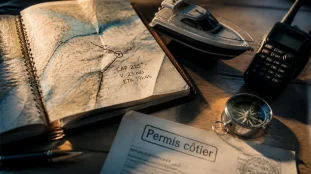
The regulation of kayak fishing depends on the environment, type of boat, navigation area and local rules. At sea, the commonly cited references are Division 240 and Division 245, which, among other things, govern recreational navigation and certain boat-related aspects. The distance limits must also be taken into account: the 300 m band, navigations up to 2 miles or up to 6 miles do not involve the same requirements. Before an exit, the safest way is to check the applicable rules with Maritime Affairs or competent local authorities.
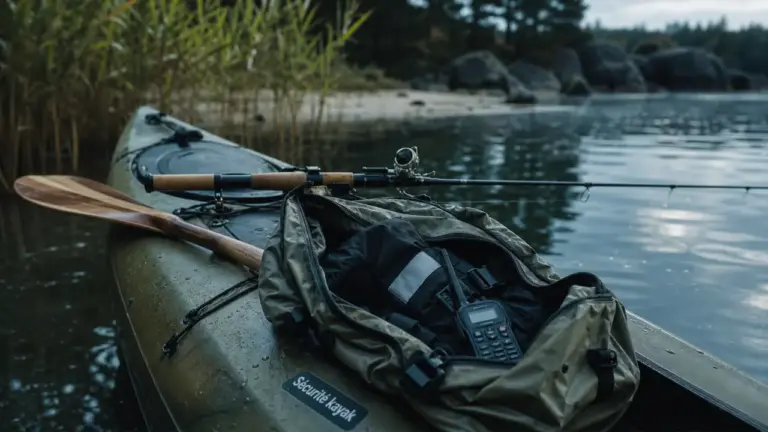
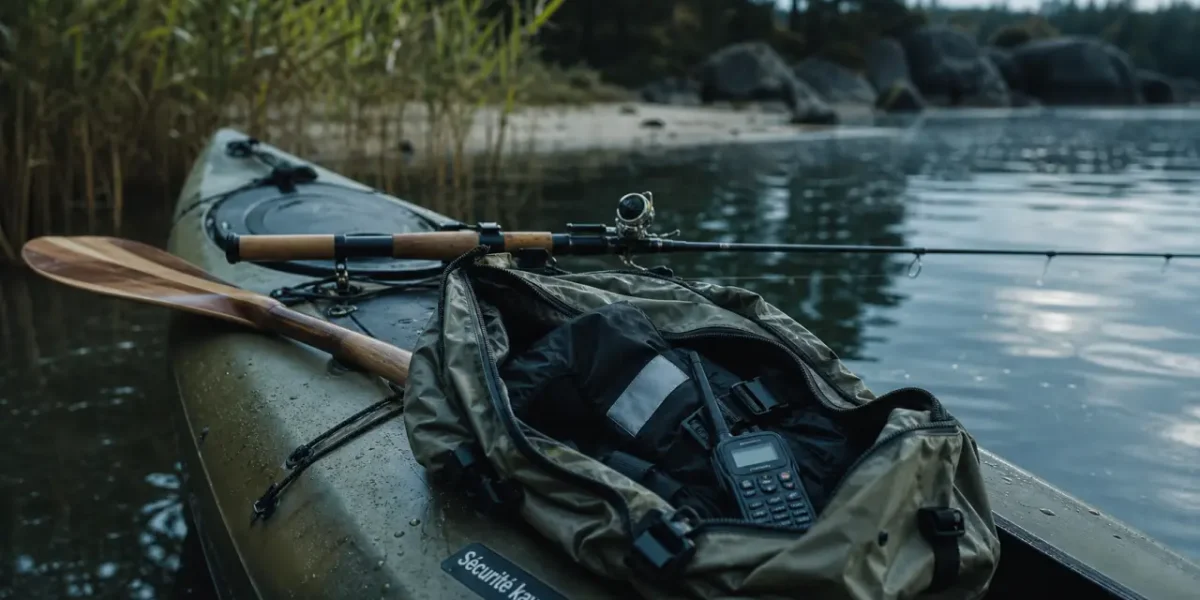
Security equipment is not a formality. Thelifejacketmust be worn, not tidy. OneVHFbecomes essential as soon as one moves away or moves at sea. The waterproof bag protects from prevent, identify, warm and return. A lamp, a whistle, a way back on board, a line of life or a pagay leash can make a difference in a common situation that gets complicated.
The weather decides more than the calendar
A beautiful day on land can be mediocre on the water. Wind against current, residual swell, late morning gusts or inshore fog quickly change conditions. For a first exit, choose a short window, weak wind, sheltered area and easy return. Notify someone of your area, your estimated time of return and avoid going out alone until the basic manoeuvres are controlled.
- Check weather, wind, tide or water level before departure.
- Wear the vest as soon as it is launched.
- Limit equipment to the essentials to remain mobile.
- Test the climb in calm conditions.
- Keep a means of communication protected from water.
Prepare his first exit and progress with others
For starters, it is best to aim for a short exit from the spot rather than an ambitious big session. One or two canes are enough, with a few soft lures, two or three swimming fishes, a pliers, a compact strainer and some cover. The goal is to learn to drift, toss, toss, correct its trajectory, pick up a decoy and manipulate a fish without turning the kayak into a floating workshop.
Progress also comes from feedback. The forums and groups dedicated to kayak fishing show how active the community is: some presentation headings total 3125 topics and 32535 messages, fishing at sea 893 topics and 81584 messages, meetings 941 topics and 26752 messages. The technical sections, with 359 subjects and 7488 messages, or photo and video, with 361 subjects and 6793 messages, allow to observe the montages, errors and material choices of practitioners.
What exit reports really learn
An exit report is not only used to show a fish. It often tells the real wind in relation to the forecasts, the colour of the water, the drift, the lure that triggered the keys, the fatigue on the return or the equipment that bothered. These details are sometimes worth more than a fact sheet. Reading several stories from the same area, we understand better the favorable periods, the areas to avoid and the level necessary to get out calmly.
Kayak fishing remains a balanced practice: light enough to keep the feeling of adventure, prepared enough to stay safe. By choosing a suitable kayak, simple techniques, controlled regulations and progressive trips, one discovers a very immersive way of fishing, where each drift learns something about water, fish and its own way of sailing.
Updated on 21 July 2026