Choosing a boat permit becomes clearer if you leave your real use: sailing at sea, exiting a river, renting a boat during holidays, jet-skiing or offshore navigation project. In France, the different boat permits do not cover the same areas or distances. This guide helps you compare options before registering by boat-school.
Contents
The right permit depends first on your navigation area
The basic rule is simple: the permit is necessary to fly a motorized pleasure craft as soon as its power exceeds its power 6 horsepower, 4.5 kW. Below, some navigations remain possible without permits, provided that local rules and safety instructions are respected. For sailboats, the logic is different: at sea, recreational permits are generally not required if the engine remains auxiliary, but may become necessary in certain motorized uses or in inland waters.
Sea, lake, river: three different logics
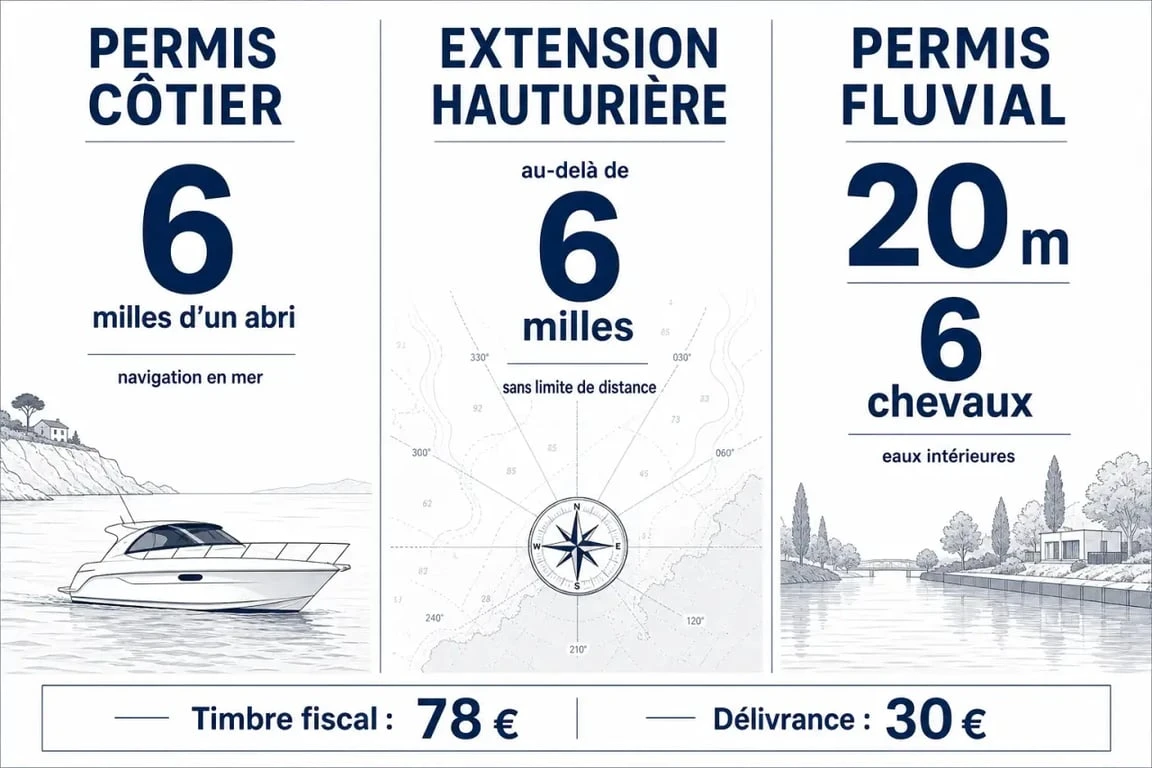
Marine navigation is mainly the responsibility of the coastal permit and, if you want to go further,offshore extension. Rivers, canals and inland water bodies are rather dependent on River permit, officially referred to as inland water option. A large lake can therefore come from another setting than an exit to the Mediterranean or a walk on the Seine: it is the regulatory area that counts, not only the type of boat.
The case of jet-skis and sea scooters
In order to drive a jet ski or a sea scooter, the permit is essential if the vehicle exceeds the regulatory power threshold, which is the case in common practice. At sea, the coastal option must be addressed; on an inland river or lake, the inland water option will be the reference. This is a useful point for those who associate the boat permit with a boat or sailboat, as it also concerns motorized water sports.
Coastal, offshore, riveric permits: what everyone really allows
The titles are sometimes similar, but their rights are not the same. The simplest way is to compare concrete uses, permitted distance and main limits.
| Permit or certificate | Main use | Key limit or condition | Standard profile |
|---|---|---|---|
| Coastal permit | Navigation at sea and jet-skiing at sea | Until 6 miles from a shelter, about 10 to 11 km | Day trips, coastal fishing, summer rental |
| Offshore extension | Navigation at sea without distance limit | Already requires coastal permit | Offshore cruise, crossings, more autonomous navigation |
| River permit | Inland navigation | Vessels less than 20 m | Channels, rivers, lakes, river tourism |
| CRR | Use of VHF in certain settings | Radio certificate issued via ANFR | Boater equipped with VHF radio, more framed navigation |
Coastal permit: the most common choice to start at sea
The coastal option recreational permit allows a motor boat to operate at sea, within the limits of 6 miles from a shelter. The concept of shelter not only refers to a port: it is a place where the boat and its crew can get safe. This permit covers a large part of recreational uses, such as walking, near anchorage, fishing, renting a motorized boat or driving a sea scooter.
Before leaving, check the weather, current, fuel, return time and fatigue of the crew. Even with a licence limited to 6 miles, the risk often comes from the combination of several parameters. A short exit remains an exit to be prepared, as the permitted distance does not replace anticipation or good navigation reflexes.
Offshore extension: to get out of the 6 mile frame
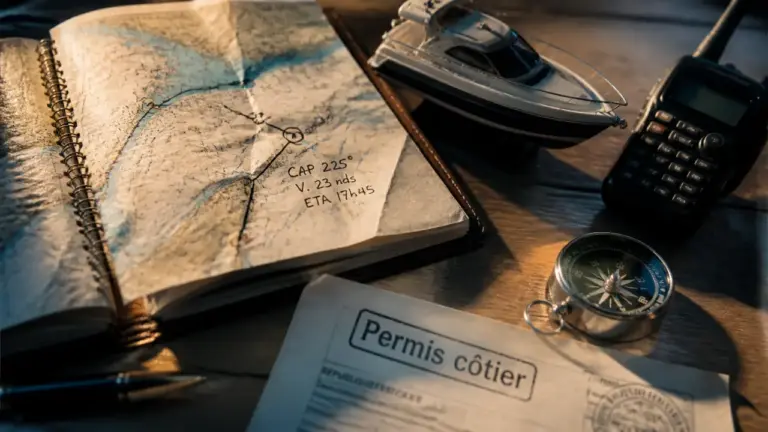
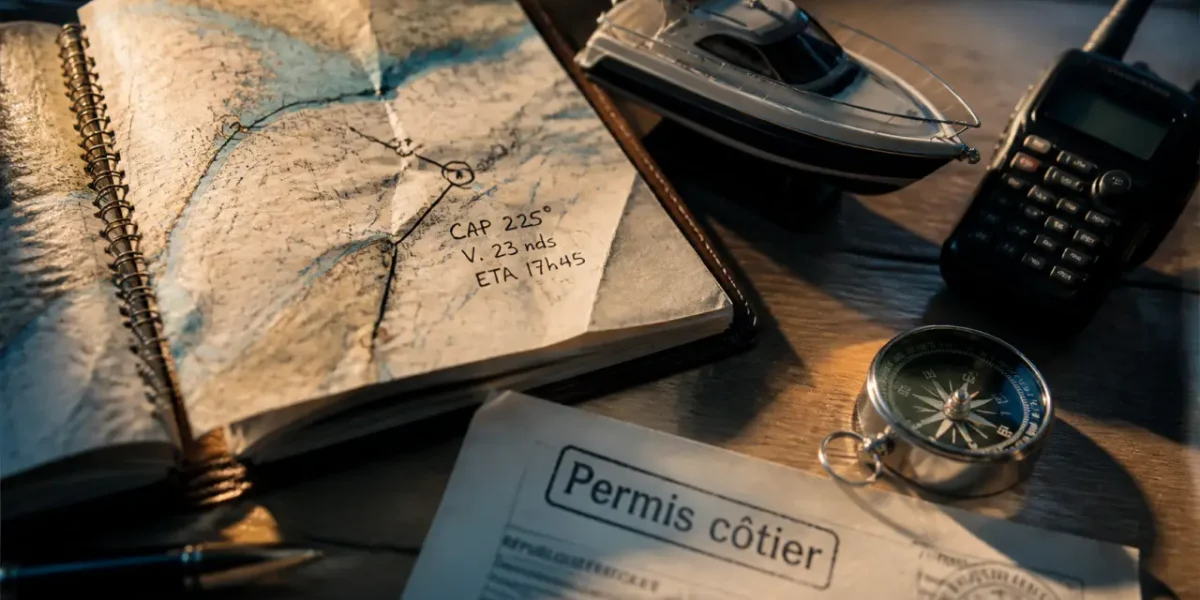
The offshore extension is for those who already have the coastal permit and want to navigate without distance limit. It requires a more technical approach: map reading, road calculation, positioning, tides and offshore safety. It is not necessary for all projects, but it becomes consistent as soon as your navigation includes crossings, night navigation or less sheltered areas.
River permit: for rivers, canals and inland waters
The recreational permit option inland waters, often referred to as river permits, allows you to navigate on rivers, canals, lakes and inland waters with a motorized pleasure boat of less than 20 m. It is suitable for slow cruises, powerful motorized penichettes, walking boats and certain family uses. Beyond 20 m, a specific extension of large inland waters must be considered.
Prices, training and examination: what to expect in practice
The budget varies according to the school boat, the region, the pace of training and the options chosen, but orders of magnitude already allow to project. A coastal permit often starts from 299 € excluding tax stamps. The river licence is also from 299 € excluding tax stamps. The offshore extension requires further preparation and begins rather from 480 €.
Administrative costs not to be forgotten
The cost of training adds the regulatory costs. You have to count one. electronic tax stamp of 78 € and registration fee for the examination of 30 €. These amounts must be included from the outset, as a fee displayed by a school can be presented without mandatory fees. To compare two offers, check what is included, such as access to courses, white exams, educational booklet, number of practical hours and administrative support.
Theory, practice, examination: the typical course
The training consists of a theoretical part and a practical part. The minimum theoretical training is 5 a.m., although many candidates foresee more time to assimilate marking, priorities, weather, sound signals, safety and road rules. Since June 2022The theoretical examination is organised by accredited private bodies. The practice takes place with the training institution and aims to check that you know how to maneuver, dock, retrieve a person by water and adopt the right safety reflexes.
CRR, VHF, card format: the complements to know
The boat permit does not cover all subjects related to navigation. Some facilities or approaches deserve to be anticipated, especially if you want to rent abroad, navigate further or equip your boat with a radio.
The CRR is not a driving licence
The CRR, or Radiotelephone Restricted Certificate, relates to the use of VHF in situations where this certificate is required. It does not give the right to operate a boat: it attests that you know how to use a marine radio correctly, follow procedures and communicate when needed. It is delivered viaANFR. For very coastal navigation, it is not always central; for a more ambitious programme, it becomes a real more security.
Modernized permit in map format
Since October 2024, the recreational permit is modernized with a credit card format and one QR code, in particular verifiable via SMART VERIFY. This evolution does not change the choice of permit to pass, but it facilitates the controls and presentation of the document. In the event of loss, theft or the need for duplicates, administrative procedures must be followed with the relevant departments, together with the supporting documentation requested.
Which permit to choose according to your navigation project?
To avoid paying for inappropriate training, start with three questions: where do you want to sail, what type of boat, and how far do you want to go? The best decision depends on your weekends, your departure port, your planned rentals and your desired level of autonomy.
- You want to rent a motor boat by the sea The coastal permit is generally the most logical choice.
- You aim for crossings or offshore navigation Start with the coast, then prepare the offshore extension.
- You are planning a holiday on canals or rivers The river licence is better suited to this use.
- You're flying a jetski. : choose coastal sea, inland waters on the river or lake concerned.
- Your engine does not exceed 6 horsepower : permit may not be mandatory, but caution and local rules remain essential.
If you hesitate between coastal and river, look at your main navigation pool. Live near a coastline, rent every summer at sea or practice jet-ski directed clearly towards the coast. Provide slow canal cruises, lock passages and river routes to the river. And if your project evolves, the extensions allow you to build your course gradually rather than go through it all at once.
The best boat license is therefore the one that corresponds to your first true navigation, not an idealized project. Start by securing your immediate use, choose serious training, and then add the necessary skills when your outings become more ambitious.
Updated on 25 August 2026