
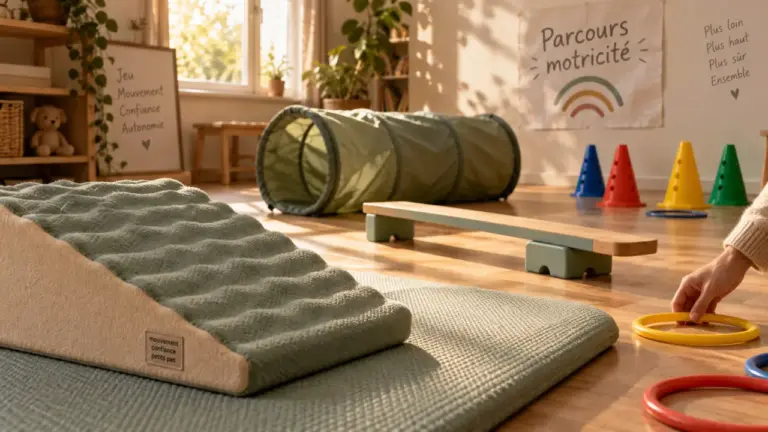
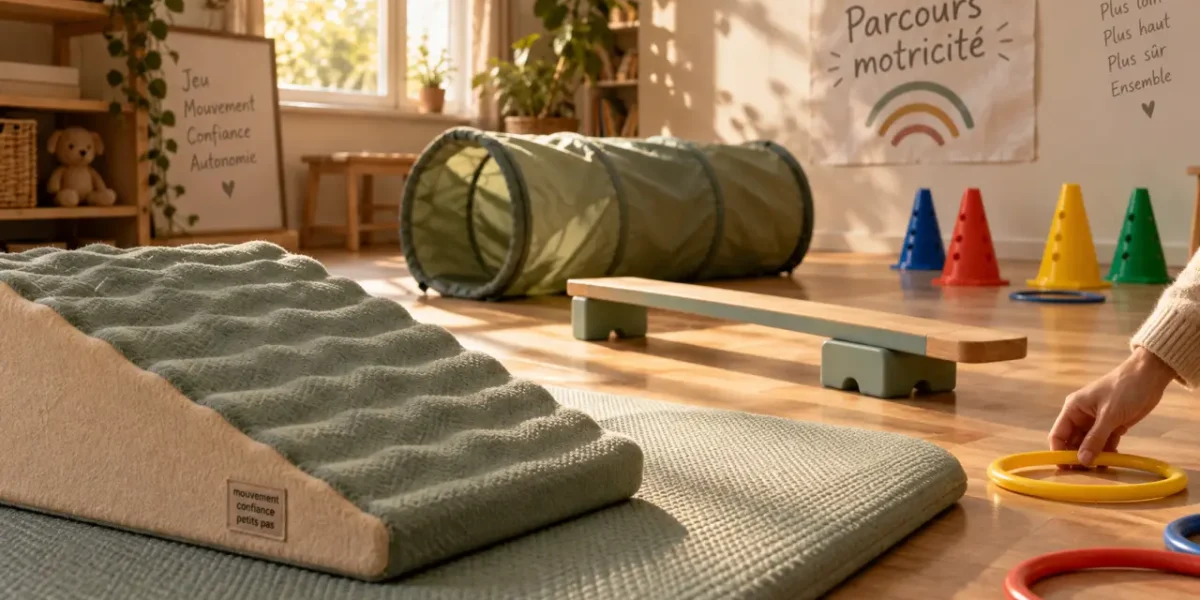
One motor path allows children to climb, crawl, span, maintain balance and test their supports in a playful setting. At home, in kindergarten or kindergarten, the right choice is not to accumulate the elements. Above all, it is necessary to compose a space adapted to the age of the children, the place available and the movements which one wishes to encourage.
Contents
A motor course, what to do every day?
The engine path follows small situations to be solved with the body: climb on a module, cross a low beam, pass through a tunnel, slide, bypass an obstacle or target a specific area. This activity calls for Overall motor, i.e. the great movements of the body. It also helps the child to gain confidence in an accessible difficulty.
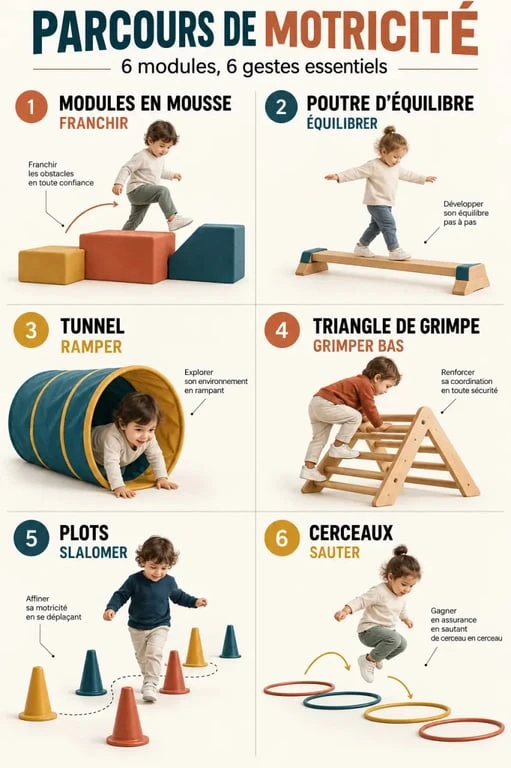
By varying the instructions, the same equipment retains its interest. The child can move up, on four legs, wearing a light object, following a color or stopping at a signal. He thus works on balance, coordination of movements, tracking in space and attention, without having the impression of following an imposed exercise.
Different uses depending on the location
At home, a compact journey meets the need to move when exiting is difficult. In crèche, it creates free exploration times under surveillance, with low modules and easy to clean. In kindergarten, it can become a structured workshop: a journey is offered, and then simplified or complicated depending on the children. In any case, the goal is neither speed nor performance, but the repetition of controlled gestures and the pleasure of trying.
Choose modules according to age, space and desired movements
Before comparing products, start with three simple questions: who will use the route, where will it be installed and what action should it promote? A course for a toddler does not require the same height or level of stability as a set for kindergarten children.
| Module type | Main use | Attitude in a small space |
|---|---|---|
| Foam modules | Climb, descend, roll, cross | Light and often moving forms |
| Balance board or beam | Stability, foot placement, concentration | Limited ground cover |
| Tunnel | Ramper, spot, cross | Can fold according to models |
| Climbing triangle or wooden structure | Climbing and controlling support | Interesting if it remains mounted in a dedicated corner |
| Plots, hoops or plastic elements | Slalomer, jump, aim | Very flexible and easy to store |
For the youngest: low, stable and legible
For a child who starts, focus on Low modules, non-slip and without abrupt level break. The foam blocks and slopes allow to move from the ground to a small height with more flexibility. Always check the age indicated by the manufacturer and do not let a young child use climbing equipment alone.
For more autonomous children: creating real choices of movement
When travel is insured, the interest comes from the combination: walking on a balance line, crossing an obstacle, crawling under an arch and then descending down a slope. Prefer a few complementary elements rather than a too uniform set. A child progresses when he or she can adjust his or her posture, choose his or her support and start over without waiting for a long time.
You can change the script without changing all the hardware. One session can be devoted to silent movement on a beam, then another to transport a small bag to a target. These variations work on balance, planning and cooperation. They also prevent the child from getting tired of an identical journey.
Compose a journey that really fits in the room
The space constraint pushes to choose versatile elements and to predict clear circulation. Measure the free zone, but also think about the margin around the course. A descent, jump or loss of balance must never lead to a moving corner cabinet, door or radiator.
A simple three-zone configuration
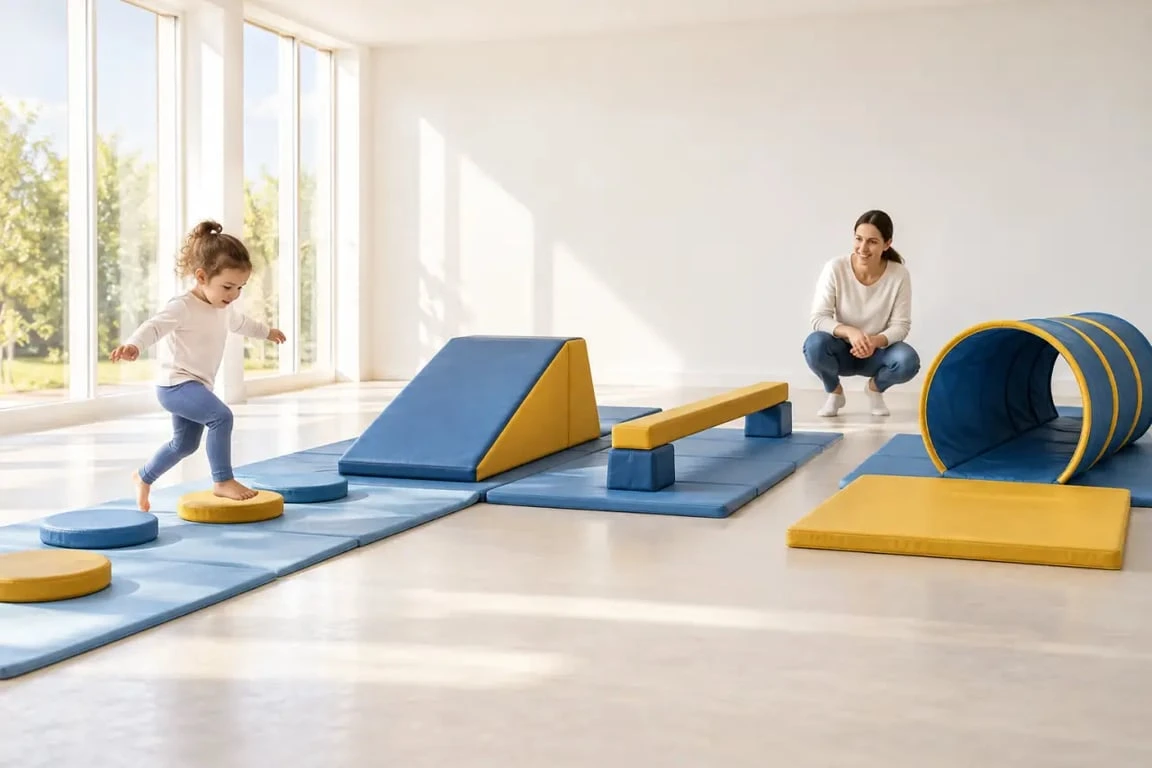
For a coherent interior journey, organize the modules in the direction of movement: a ground starting area, a challenge area with a crossing or a balancing exercise, then a clear arrival. Avoid crossings where two children may encounter each other. In a living room, two or three elements are often enough: a foam slope, a low equilibrium board and a tunnel, for example.
- Delimit a quiet space, on a stable and clear ground.
- First install the heavier or less mobile elements.
- Test the course at child's height: access, exits, distances and fall areas.
- Offer a unique and understandable rule, like waiting for the trip to be free before leaving.
- Change one parameter at a time to keep markers.
In the community, rotation is useful. While a small group evolves on the psychomotor path, others can participate in a quieter activity. This organization reduces waiting, facilitates supervision and allows each child time to explore without being rushed.
Security, maintenance and procurement criteria not to be overlooked
Safety begins with a product intended for use and age but continues at each facility. Consult the manufacturer's instructions, warnings, conditions of use and compliance information available at the time of purchase. Customer reviews can provide information on ease of assembly or timekeeping, without replacing these checks.
Checks to be done before each session
Inspect attachments, surfaces, seams and stability of modules. Foam equipment shall retain its shape and shall not have a torn cover. For wooden or plastic structures, look for cracks, damaged edges and loose parts. A suitable carpet can improve comfort on the ground, but does not dispense with active monitoring by an adult.
Removable and washable covers simplify family and nursery maintenance. Clean the surfaces according to the manufacturer's recommendations, let them dry completely and store the elements in a dry place. Remove any damaged or unstable module from the course immediately.
Compare budget without buying too big too fast
The offers cover very different formats, from the small wake-up kit to the modular set for collective use. Examples of observed prices lie between 69.48 € and 139,90 €, but the price varies greatly depending on the number of parts, dimensions, material, the possibility of reconfiguring the set and the accessories included. A higher price can be justified by a washable cover, a more robust design or a better modularity. It alone does not guarantee a better fit.
For a first purchase, prefer a core of two to four modules covering several actions: crossing, balancing, crawling or climbing low. Then add an item only if use reveals a real need. Families can compare age filters, exact dimensions, return conditions and reviews. Professionals will benefit from checking resistance to repeated use and easy disinfection.
A successful motor path remains evolving: the order of the modules is changed, the difficulty is adjusted and what no longer corresponds to the child is removed. This flexibility makes the investment more sustainable than a large fixed set, while keeping physical activity within reach.
Updated on 22 September 2026