In order to make lasting progress in rowing, two axes are necessary for all rowers: to develop a real muscle strength, and to build a solid endurance, able to hold the distance during long trips as intensive club exercises. Here you will find structured advice, concrete exercises and examples of club-tested planning, accurate and without unnecessary jargon.
Contents
Muscle pressure and its importance in rowing
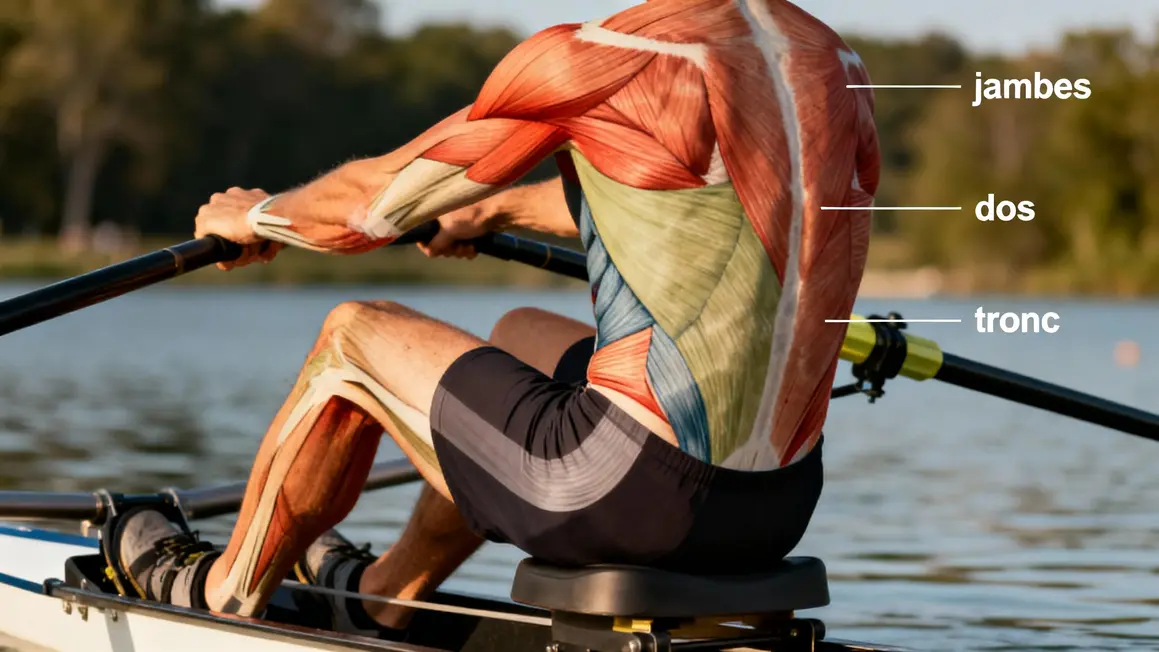
A set of muscle groups is required. Legs form the main engine: each rowing stroke rests above all on the rapid extension of the hips and knees. The quadriceps, ischio-legs and Buttocks work in synergy to propel the boat. Accurate coordination is essential to transmit power to the end of the pallet.
The back and shoulders intervene in the second phase of movement. Large backs, trapezes and rhomboids ensure traction when the arms bring back rowing. The shoulders strengthen stability and contribute to technical quality. Support for a correct posture protects the back and optimizes the effectiveness of the gesture, an issue that club coaches in Rhône-Alpes regularly stress, especially during the collective sessions on the Rhône or the lake of Aiguebelette.
The trunk, especially the abdominal belt and deep muscles like the transverse, plays the role of relay between legs and arms. A solid strap promotes rowing stability and limits energy losses. Often, the difference between two technically close rowers is observed in their ability to hold the sheath at the end of the race or under difficult conditions (wind, clapp).
A good balance between strength and endurance makes it possible to progress without risking injury. A rower developing excessively the legs without integrating the work of the trunk often ends up unbalanced the cycle of the blow. Conversely, reinforced sheathing and developed endurance offer not only power, but the ability to maintain it on the distance.
Care for whole body Therefore avoids pain, optimizes effort and promotes season-to-season progression, a shared observation in clubs participating regularly in regional regattas.
Muscle-building exercises for rowers

Targeted muscle preparation is the asset of regular rowers. The following are the reference exercises by area and level:
Squats: the base for powerful legs
- Beginner : Squats by body weight – 3 x 12-15.
- Intermediate : Squats light bar – 3 x 8-10.
- Advanced : Heavy squats – 4 x 6, maintaining the rigorous technique.
Warning : right back, knees never beyond the foot tips, controlled descent.
Deadlifts: strengthen back and posterior chain
- Beginner : Light stops – 3 x 8.
- Intermediate : Classic Deadlifts – 3 x 6-8.
- Advanced : Progressive Deadlifts – 5 x 5.
Think about: keeping the bar close to the tibias, flat back and progressive load (avoid lumbar injury).
Tractions: wide and solid back
- Beginner : Assisted Tractions – 3 x 8-10.
- Intermediate : Free Tractions – 3 x 6-8.
- Advanced : Lestated Tractions – 4 x 5.
Focus on movement control to limit compensation.
Gaining: abdominal belt and injury prevention
- Beginner : Board on elbows – 3 x 20-30 sec.
- Intermediate : Plank + lift alternate legs – 3 x 30-40 sec.
- Advanced : Unstable board – 3 x 45-60 sec.
Practical tip : neutral posture, systematic heating.
Precautions when strengthening
Good heating mobilizes joints and prepares muscles (Minimum 10 minutes). Use appropriate loads, gradually increase, stop in case of pain, schedule days of rest. This is a rule common to all health sports sections and regional competitors.
The role of endurance in rowing
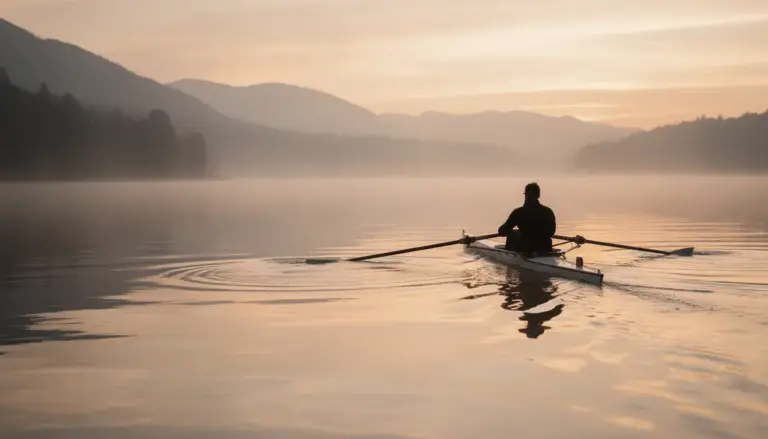
A long session with low intensity remains a pillar of training, with a rate around 18-20 strokes/minute 75% FCM. In Rhône-Alpes, rowers prefer these trips over 60 minutes, on ergometer and above all on the water, taking advantage of the diversity of regional water bodies.
The long intervals make the aerobic resistance work: series of 6 x 8 min with 2 min of active rest are regularly integrated into the regional cycles. The alternation between sustained effort and recovery prepares for long races and intensity fluctuations related to navigation in the underwind zone.
Take advantage of these sessions to work on technique (amplitude, slow return) and precise effort management, a point regularly discussed at federal workshops, accessible via local clubs.
Training period: structure its progression
The sport year is divided into different phases, each cycle meeting objectives:
- General preparation: endurance base (railway, bike, technical), lightweight strength building. Various sessions, overall objectives.
- Specific preparation: work on intensity, targeted intervals, heavy loads in strength and advanced technique.
- Competitive phase: decrease in volume, increase in intensity, running sessions, analysis of performance indicators (time over 500 m, sensations, heart rate).
- Recovery: decrease in volume, maintain frequency, mobility and light sheathing.
The partner clubs of the row-rhone-alps network adapt these cycles to their functioning, with microcycles (1 week) and macrocycles (up to 3 months) to stick to the federal and regional calendar.
Training plans adapted to each level
A six-week program promotes measured change. Examples:
Beginners
- Soft endurance 3x/week (20 min to 18-20 cpm on ergometer or double).
- Single split: 5 x 4 min at 20-22 cpm, active recovery.
Intermediate
- 6 sessions/week alternating long durations (40 min to 18-20 cpm), short fractionated (10 x 1 min to 24 cpm, recovery 1 min), one strength session.
- Raise intensity and variability week after week (advised by Rhône-Alpes educators).
Advances
- 6 to 9 sessions/week: long endurance (70 min to 18 cpm), intense intervals (3 x 5 x 500 m at 26-30 cpm, little rest), technical exit and reinforced sheathing.
- Programming based on the competition calendar and results (regional regatta calendar).
| Level | Objectives | Recommended frequency | Standard session |
|---|---|---|---|
| Beginner | Technique, soft endurance | 3-4 times/week | 20 min at 18 cpm + single split |
| Intermediate | Power, endurance balance | 5 to 6 times/week | 40 min + 10 x 1 min at 24 cpm + bodybuilding |
| Advanced | Specific work, intensive management | 6-9 times/week | 70 min + 3 x 5 x 500 m at 26–30 cpm |
Local Club Council : adapt these plans to your reality (meteo, schedule, rest phases). A stable progression is better than accumulating fatigue. The site offers regular news on regional training and internships, useful for adjusting its practices (our training in Rhône-Alpes).
Equipment and tools for effective training
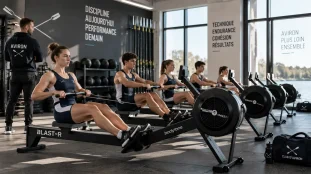
The choice of equipment determines the quality and safety of the training. In the room, prefer modern ergometers (concept2 or equivalent models), combined with a few dumbbells and carpets for reinforcement. The rowers of local clubs also use cardio watches or tracking applications (e.g. Rowing in Motion or assenei) to monitor their evolution.
On the water, adapt the choice of boat: skiff to progress solo, double for the pair, four bars for the collective. Carefully adjust swimming lady height and row length, well-known advice from basin leaders on the Leman or the Rhône.
To understand why row training is based on the balance between technique and physical effort, discover rowing: demanding sport or irresistible regional passion.
In addition to exercises to boost your endurance, discover how the laviron protects the heart and reduces the risk of hypertension.
To optimize your rowing performance, discover how to eat 150 g of protein per day: a practical guide for d'aviron athletes in Rhône-Alpes and adapt your diet to your goals.
Elementary accessories: breathable clothes near the body, anti-bulb gloves and well fixed gourd. According to the very variable weather of the region, a waterproof windproof jacket is never too much.
For optimal follow-up, head to digital tools designed for rowing: connected applications, software coupled to rowing or GPS. They centralize speed, rate and recovery data, facilitating the driving of training and sporting appointments.
Managing risks and preserving health in training
The most frequent injuries result from repeated efforts and imperfect postures. Plan a real weekly day of recovery, vary the intensities, and be accompanied by an educator in case of technical doubt.
Observe a precise posture on rowing machine as on water: right back, lined wrists, controlled flexion of the bust, identical tips for all ages and levels, especially from rhônalpin club returns during the days « row safety » Locally organized.
Integrate systematically (10 min, dynamic movements, mobility) and targeted stretching at the end of the session. Feed yourself « useful » : complex carbohydrates before effort, protein for recovery, continuous hydration, points mentioned during the health workshops led by the local League.
All of these principles, shared on the ground by mentors and practitioners, promote a safe and measurable progression for all the active profiles of Rhône-Alpes.
Ready to adjust your program or share your workout experiences? Comments are open for advice, specific exercise ideas, or feedback on club or solo sessions in the region. Don't hesitate to pass the article on to your team partners or newcomers to the self-help club is the first strength of the rowing community.
What points would you like to see in-depth on practical training? Offer your ideas in the comments area, and find other useful resources on the French Federation ofviron website or on the medical portal of INSP for health sports.
Everyone has their pace, plan, and progress: share our best practices to advance together regional rowing and continue to vibrate on our water with confidence.
Marie F., federal coach, regular contributor to the Aviron Rhône-Alpes network since 2019.
Updated on 21 March 2026