

Since my first trainings on the banks of the Rhone, I realized that no stride really resembles one another: each one evolves at its own pace, driven by its desires and its state of the day. What makes the difference is to find this fragile balance between pleasure, regularity and the feeling of progress. With this table speed running, the objective is clear to offer concrete benchmarks to better situate you, refine your objectives and, above all, experience this particular satisfaction to move step by step towards the form that suits you, regardless of age or experience in discipline.
Contents
Speed chart: find your ideal look today
Many of you wonder if your walking speed corresponds to "the norm", or how fast to move forward. The reference table, based on recognized sources in health and sport, shows the speeds of walking by age, sex and level of fitness. In other words – an adult usually walks between 4.5 and 5.1 km/h, fast walking starts around 6 to 7 km/h, and the caloric expenditure follows the pace.
This table allows for easy identification, self-assessment of progress, and targeting the right goals, even without advanced technical concepts. All you have to do is follow the instructions: everything is designed to ensure that each walker finds himself, whether the motivation is high or stable.
| Age | Level/Form | Women (km/h) | Men (km/h) | Remarks |
|---|---|---|---|---|
| 20-40 years | Average | 4,7 – 5,5 | 5,0 – 5,9 | Standard leisure/health |
| 20-40 years | Quick/Sport | 6,0 – 6,7 | 6,0 – 7,2 | Sports March |
| 41-60 years | Average | 4,3 – 5,0 | 4,5 – 5,3 | Moderate age effect |
| 41-60 years | Quick/Sport | 5,5– 6,3 | 6,0 – 6,8 | Tonic objective |
| 61+ years | Average | 4,0 – 4,5 | 4,2 – 4,8 | Senior standard |
| 61+ years | Quick/Sport | 5,0 – 5,8 | 5,4 – 6,3 | Very good maintenance |
Zoom: concrete equivalences to be found in everyday life
In fact, 10,000 steps correspond to about 7 km, almost 400 kcal for a 70 kg person. During a slow walk (3.5 km/h), more than 170 kcal are already spent on 5 km; At 6 km/h, the effort climbs and you will melt nearly 280 kcal. A podologist recently recalled in a workshop that these figures often motivate those looking for a sustainable activity rather than a one-off exploit.
Understand the categories of slow, moderate, fast... and "sportive" speed
Behind each measure, there is above all a feeling. How do you make the difference between a recovery walk, a tonic walk or a really sporty approach? This cutting helps to find it according to its motivation of the moment.
Slow, moderate or fast: what does it feel like?
Walking at less than 4 km/h, the look remains relatively relaxing, ideal to get back into the legs after a break or to stroll without pressure. Around 4.5 to 5.5 km/h, the heart and joints work at a good pace, without any noticeable shortness of breath, is the area often considered the health base. Starting from 6 km/h, the situation changes: the effort becomes clearly more perceptible, breathing and posture are activated, some even discover a real passion for the power walking (and it is not uncommon to meet former riders in reconversion!).
Express test: Time your kilometer. If the time varies between 10 and 13 minutes, you are on a healthy look; Within 10 minutes, you pass in the fast walking category! A trainer explained to his students that sometimes only one time frame changes the perception of his progress.
Why consider age or sex?
Over time, the speed of walking naturally tends to decrease by a little more than1.2 minutes per km between 20 and 60 years. However, this does not sign a stop: many people, with a suitable program, find that they are regaining their past speed or setting new challenges. I saw some senior walkers turn their routine into a real challenge, especially after registering for a local club.
How to measure walking speed (simple methods and magnifying tools)
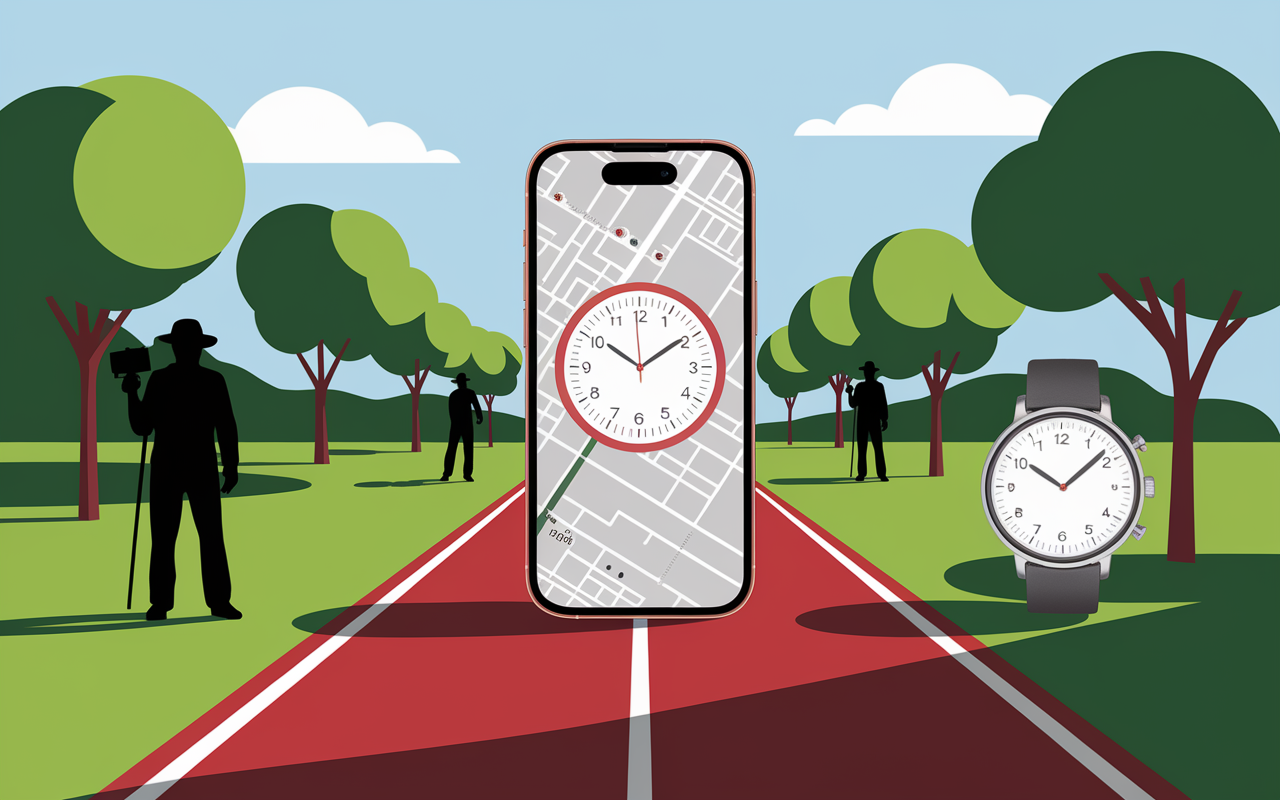
No need for sophisticated instruments or subscriptions to track progress: three accessible options allow you to check the speed of walking, even during an improvised exit.
Practical methods for self-assessment
The most direct: choose an easy-to-memorize finish point (park, business, or bus stop), measure distance by map or application (Google Maps does the job perfectly), and note the time taken.
- ✅ To get your speed (km/h), divide the distance travelled (km) by the time taken (h)
- ✅ For example: 1.2 km in 15 min results at 4.8 km/h
Another option: enable the GPS of a smartphone, for example with Strava, Runkeeper, or Komoot (average rating 4.3/5 on over 200 reviews by industry comparison). The connected watches and bracelets also incorporate this function; They also count the steps in automatic.
Fun experience: In my family, we sometimes mark 1 km in the park with a simple red ribbon, each one tries its "time gauge" and the surprises are regular, especially for teenagers!
Custom simulators and calculators: motivating tools
To go further, many specialized sites offer free simulators: inform your distance, your time, some additional data the estimation of calorie spending and speed falls instantly. Some calculators even generate a custom PDF table, very convenient to follow it week after week.
Let's note that simulators allow us to have a clear idea of progress, while connected objects regularly create the small « trigger » who pushes to walk out one night of rain (several coaches see it at their customers).
Choose the right look according to its goals: health, weight loss, performance
The challenge is not to aim for a medal, but to combine pleasure, well-being and tangible results, each walker can find the right combination.
Moderate daily ignition: for the health goal
International bodies (WHO) recommend a minimum of 150 min moderate physical activity per week. In plain terms, walking between 4.5 and 5.5 km/h for about 30 minutes a day is enough to preserve the heart, endurance and good joint mobility.
Small reminder: 7,000 to 10,000 steps/day, around 5 to 7 km, already generates significant health benefits and spends between 300 and 400 kcal. A specialist kine told me that this is a regularly decisive course for her less athletic patients.
Weight loss: when fast walking makes the difference
To stimulate fat loss or strengthen, it is best to opt for the "fast walk" (6 to 7 km/h), dynamic posture and well engaged arms! Over 5 km, fuel consumption can rise to 280 kcal (considered for a 70 kg gauge).
Some walkers whom I accompany testify that, thanks to a few "boost" sessions each week, body change is felt without disrupting the diet or social life a sports dietician also mentioned at a recent conference.
Sports performance and walking: how far to go?
Want a personal challenge? Why not test the Nordic walk, sticks in hand, which often shows speeds beyond 7 km/h... Fast walking competitions can go up to 8 or 10 km/h, but then it's better to progress step by step.
Some professionals insist on progressivity – increase one parameter at a time (time, speed or distance), and always rely on its sensations of the moment. Is it really useful to look for performance from the first exits? Everyone sees noon at their door.
Key factors and precautions for calm progress
A set of details play on your progress and safety. Let's see in concrete terms what can affect speed, and how to avoid frequent mistakes with some field tricks.
Which influences speed (and how to easily adapt)
Morphology, terrain diversity, weather of the day, choice of shoes or physical fitness: everything can change the sensation. Some paths, in the rain or with new shoes, sometimes reserve real surprises!
- ✅ Watch for unusual fatigue, any persistent pain, or the appearance of more severe shortness of breath than usual
- ✅ Do not hesitate to modulate the less favourable days or change the course in order to keep the motivation and limit wear
Personal wink: on gravel near the Rhone, it sometimes loses 0.5 to 1 km/h, while on bitumen, the stride becomes more natural again. It also happens that a simple change in weather will make the performance vary.
Safety and limitations (including after 60 years)
Vigilance remains the best ally after 60 years or in case of chronic illness. Ideally start at a small pace, prefer suitable surfaces and ask a professional for advice if needed to build a secure plan. Engaging in a walking routine, even at the age of 70 or 75, generally strengthens balance and autonomy – a generalist recently mentioned the importance of a suitable rhythm among seniors.
To better understand sports performance, learn how to easily convert sports 100mph in kmh in water sports.
To complete your fitness goals and vary your workouts, discover also the bicclette eu: complete guide to types, innovations and trends 2025.
To optimize your walking sessions according to your age and goals, discover how many minutes walk every day to really stay fit.
In practice, walking less quickly over time is not worrying, as long as the regularity and listening to his feelings persist.
FAQ: Your questions about walking speed
Small overview of the questions that come back most and for any additional questions, consider testing our simulators or recovering a personalized guide if needed.
What speed do you consider "normal"?
A healthy adult typically changes between 4.5 and 5.1 km/h, and, after 60 years, the average is rather around 4 to 4.5 km/h. These are the figures commonly used by specialists.
When does walking become "fast"?
From 6 km/h, we switch to the fast walking category. It is not uncommon to reach 6.5 to 7 km/h With a bit of experience parked with clothes too thick, sweating occurs quickly!
How to get his personal speed?
Time a known journey: 1 km travelled in 12 minutes corresponds to 5 km/h. Even simpler, some applications or watches, popular and rated more than 4,3/5 by their users, do the calculation in your place. Several followers say that they thus discover their progress without worrying about the raw figures.
What calorie expense according to speed?
Over 5 km, we spend 220 kcal at 4 km/h, or 280 kcal at 6 km/h. For example, 10 000 steps (7 km) represent about 400 kcal burned for an average weight of 70 kg. At the educators' meeting, this calculation is regularly discussed according to the real conditions on the ground.
Which accessory or tool actually follow?
Watch and bracelets are still safe values: the best rated models usually get reviews around 4.3/5 after the specialized sites. However, many prefer a simple paperboard or an application to print to follow their sessions more freely.
Should we slow down in case of health concerns?
Be careful: start gradually, do not hesitate to consult your doctor in case of doubt, and progress slowly. It is better to maintain a smooth and regular walk than too intense an effort, a factor of demotivation or heart problems. Several specialized nurses support this in prevention workshops.
Does walking speed affect overall health?
Absolutely, according to many studies: a sustained walking speed, adapted to each age, is related to greater autonomy, and a reduced risk of falling among seniors. This concept is often used in training for accompanying persons. We must recognize it, we rarely hear this reassuring message enough!
Last point to remember: tailor-made, fun, and a truly adapted walk
Now you have all the necessary benchmarks to locate your speed, refine your ambitions and observe your evolutions. Remember to check your comfort regularly, vary the pleasures according to your moods or the weather, and enjoy every exit. Simulators or guideboards are always within click to encourage from one week to the next.
Who knows, maybe we'll meet one day on one of the roads of the Rhône... And remember, every step is important, even when you don't see it right away.
Updated on 21 March 2026