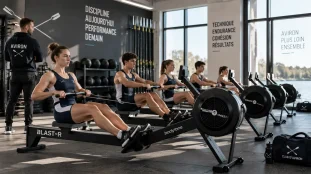


Integrate sport in its daily routine, even juggling with constraints and small doubts, remains perfectly realizable: I share with you the gaze of an old rower, coach and parent, convinced that progressivity, concrete benchmarks and a self-destructing tip transform the recovery into a collective adventure and not just an individual challenge. In this article, you will find tips and anecdotes from twenty years on the rhônalpine water: the idea is really to demystify the usual blockages, make thephysical activity a source of simple pleasure, and offer you reliable benchmarks for each first step, without unnecessary pressure.
Contents
Getting to sport: an accessible and reassuring method for crossing the first course (even if hesitation dominates)
Many are wondering how to start sport on a daily basis: the good news is that it is never too late, nor too complex to start moving again, even with an already busy schedule or full of questions. Adopting a tailored progression, adapted to the reality of each person, allows us to finally establish a lasting habit... without yielding to pressure or guilt. Here's what we can remember to overcome blockages and make sport accessible to all, according to your own criteria.
- Why go to sport: benefits and clicks
- How to choose the most suitable sport
- First steps: organization, equipment and practical methods
- Lift brakes: motivation, lack of time and other blockages
- Practical tools and applications
- Beginners' FAQ: 6 essential questions
- Experience stories and inspiring testimonials
- Simulate your schedule or download a useful checklist
Why go to sport: immediate benefits and concrete daily clicks
Starting or resuming, it's not just a matter of silhouette: these small changes offer a real air bowl to the body and mind. From the first few weeks, physical activity acts as a painkiller, improves sleep quality and mood, while contributing to self-confidence when you start moderately. In concrete terms, a quick walk of about twenty minutes is enough to make the difference. Who set the rule of great revolutions from the beginning? Some coaches also say that they have seen whole groups change their mindset through simple sessions.
Real benefits, without an illusory promise
It is regularly observed that energy increases, stress decreases, and the risk of common diseases (cardiacs, diabetes, back pain...) is gradually decreasing. Many public recommendations propose to target between 150 and 250 minutes weekly moderate activity: this can result in four sessions of 40 minutes, or about ten minutes a day, and this format remains effective. Essentially, it is to avoid the logic of "all or nothing" every action remains beneficial.
- The mind is strengthened: anxiety recedes, trust rises;
- Reduction of chronic pain or injury, according to the opinion of some sports professionals;
- Sleep improves, and daily energy also – a true virtuous circle;
- The motivation for other areas (food, time management, etc.) is increasing.
One trainer mentioned that on several re-introduction programs, more than 5000 members found concrete benefits from the first weeks, even after several months of sedentaryness.
How to choose your sport? Efficacy is regularly found where it is the simplest
The real secret of a solid start is to combine pleasure and practical reality: schedule, desires, budget, possible pain. Rather than looking for "the best sport", it's really worth exploring: what's it all about? Where can I start without difficulty? Am I more comfortable alone or accompanied? Trends are not always right: simplicity prevails. Moreover, it happens that an adult discovers unexpected pleasure in a disliked, younger discipline.
Benchmarks to guide your choice of activity
In practice, there are a few useful avenues, depending on the context:
| Profile/Contravention | Adapted sports |
|---|---|
| Lack of time | HIIT (20 min), fast walking, house strengthening, fast dancing |
| Fear of judgment or start | Yoga soft, Pilates, app coach, solo bike |
| Wish for atmosphere/group | Group classes, walking clubs, aquagym, adapted gym |
| Joint pain | Swimming, elliptical bike, soft gym, stretching |
| Forced budget | Home sports (free app), walking, jogging, free platforms or local clubs |
This is also why some practitioners evoke pleasant surprises: it is not uncommon, for example, that a neighbour who rejected the younger bike becomes today a local ATV ambassador; adult feeling often varies radically.
First steps: organize your schedule, equip easily, start smoothly
There is no need for sophisticated equipment or a miraculously clear schedule to cross the course. Experience, the principle that I always apply to beginners is the "just enough": planning two to three short slots each week, planned in the usual calendar, really changes the dynamics. Simple material (baskets, gourds) is enough, and progressivity limits the fear of technical falsification.
Structured routines without pressure or exhaustion
What counts above all is regularity, not excessive intensity. Popular recommendations recommend starting with 2 reinforcement sessions of 20 minutes and 1 to 2 aerobic sessions (walk, dance, bike) from 30 to 45 minutes: you then reach the threshold of 150 to 250 min hebdoeither the time of a TV series or a good shared meal.
Note to progress calmly:
- Put your slots on the agenda, like any convenient date: this habit reduces the temptation to push back;
- Prepare an inside emergency plan: home circuit or video-guides, in case of capricious weather or reduced motivation;
- Bet on the movements you already know how to perform (useless to start off on too technical);
- Evolution naturally settles, without pressure: no one crossed the Rhone Valley from the first attempt!
Some members of the WhatsApp group "Resuming Parents in Press" testified that by simply spacing two 25 minute sessions each week, it becomes possible to keep close to 28 meetings in two monthsplanning just before the kids bath changed the deal for them.
Lifting the brakes: fluctuating motivation, lack of time, apprehensions... how to do it?
Fatigue, fatigue or the famous "mental load" each impact at some point. The key is to learn to go through these episodes without excessive self-accumulation: overcoming each obstacle is close to regularity. The recognition of classical mistakes remains, according to some coaches, a decisive step. It can be assumed that the heading of the "I will never hold" is effaced, provided that we agree to miss a few sessions without too much dramatizingce is not always obvious, moreover.
To improve your endurance and see tangible progress, learn how to integrate 1 hour of cardio per day: actual results, deadlines and tips for all in your sports routine.
To stay motivated and inspired throughout your sporting career, consult Sportrip actu sport: your key source for daily sport, an essential resource for all enthusiasts.
Adopting regular physical activity may seem intimidating, but choosing suitable exercises, such as cardio, can not only strengthen your endurance but also optimize your results for the weight loss through cardio.
Simplify and surround: useful reflexes against stalling
In addition, several possible options facilitate recovery:
- Adopting Progressivity: A Brief Session of 10 minutes is always better than nothing, especially at low times;
- Building on group dynamics: WhatsApp, Facebook or volunteer coaches promote regularity. Feedback on some programs exceeds 5000 members assets;
- Using play tools (free apps, training simulators) helps to stay motivated (e.g. Decathlon Coach, Ownsport, evaluated at 4.9/5 on 1918 reviews);
- Accepting imperfection: missing a session does not erase everything else. It is recommended that you try again the following week.
Good to know
I recommend that you adopt progressivity by favoring even a 10-minute session during demotivation moments: it is always beneficial and easier to maintain over time.
Some remember the phrase of a rower: "I often missed my slots, but I didn't let go, because every Monday, the app sent a motivating tip that I could test the next day".
Practical tools, free apps and programmes to test serenely
The sport accessible to all is today: schedule simulators, free applications, PDF to print, online sessions, shared offers (student clubs or families). Even with a limited budget, the time has never been so good to get started. Do you still hesitate about the most suitable formula? A physical activity expert reminded a webinar that the essential is usually to test without commitment.
Panorama of concrete solutions to discover
Some levers allow you to cross the level without concern:
- Free applications: Decathlon Coach, Nike Training Club, Ownsport (nearly 4.9/5 on more than 1900 tests);
- Local clubs: insurance from 17 € per year, many clubs offer free trials or discounted rates;
- Mutual health: some cover part of the sports packages from 4.90 €/month;
- PDF/simulator guides: available from many partners, to organize your sessions or test a typical schedule.
In case of pathology or marked overweight, medical consultation is often recommended before starting. This step brings serenity, and sometimes boosts motivation by reassuring his health.
Updated on 21 March 2026