
A mass intake diet is based on controlled calorie surplus, sufficient protein and progressive strength training. Eating a lot is not enough: the goal is to support muscle building without unnecessarily accumulating fat. The right starting point is to measure your habits, then increase your portions in steps.
Contents
Fix the calorie surplus from your daily life
Your maintenance calories correspond to the energy needed to stabilize your weight. They depend in particular on your weight, age, professional activity and training. A calculator estimates the basic metabolism, then applies a level of activity, but its result remains a hypothesis to be tested.
To get a concrete mark, note your meals for about two weeks and weigh regularly in similar conditions, ideally in the morning. If your average weight remains stable, your average food intake approaches your maintenance. This observation is often more useful than a random calorie target.
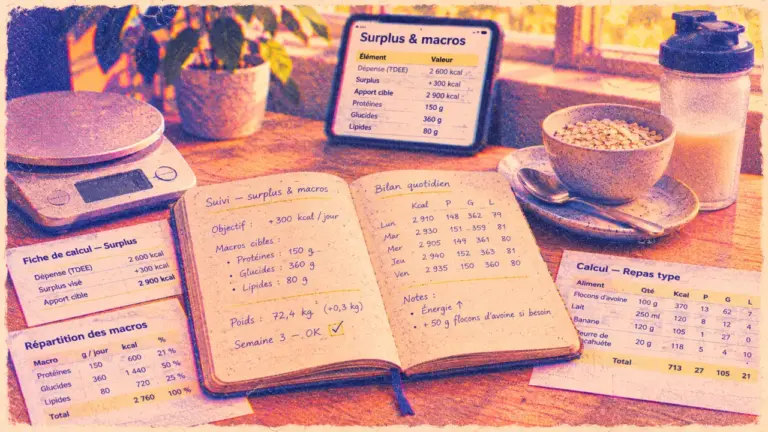
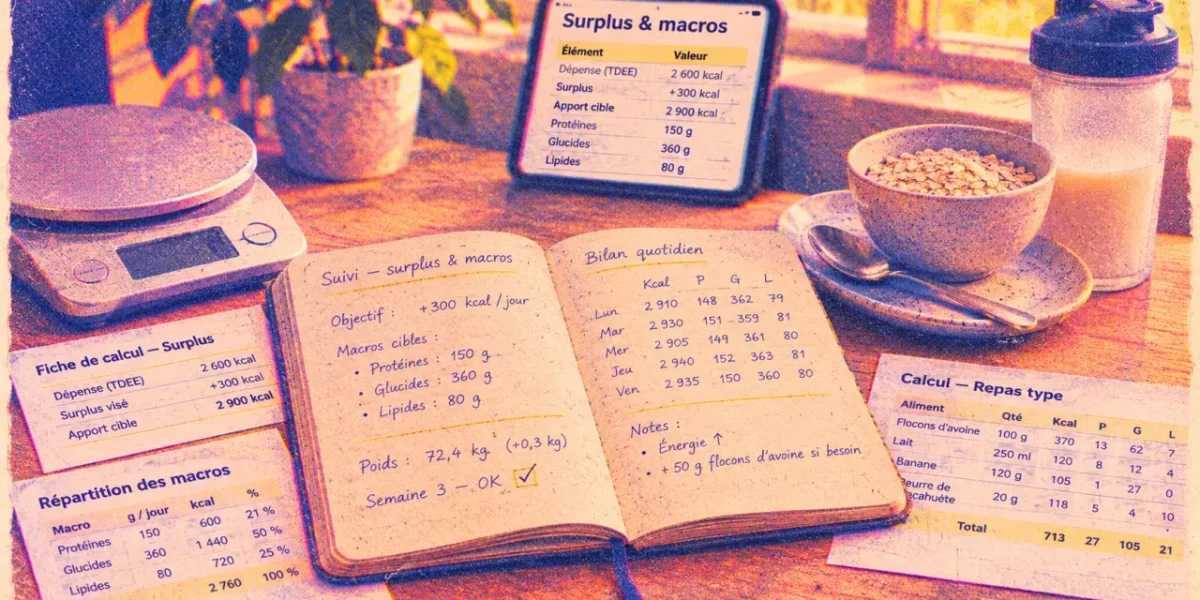
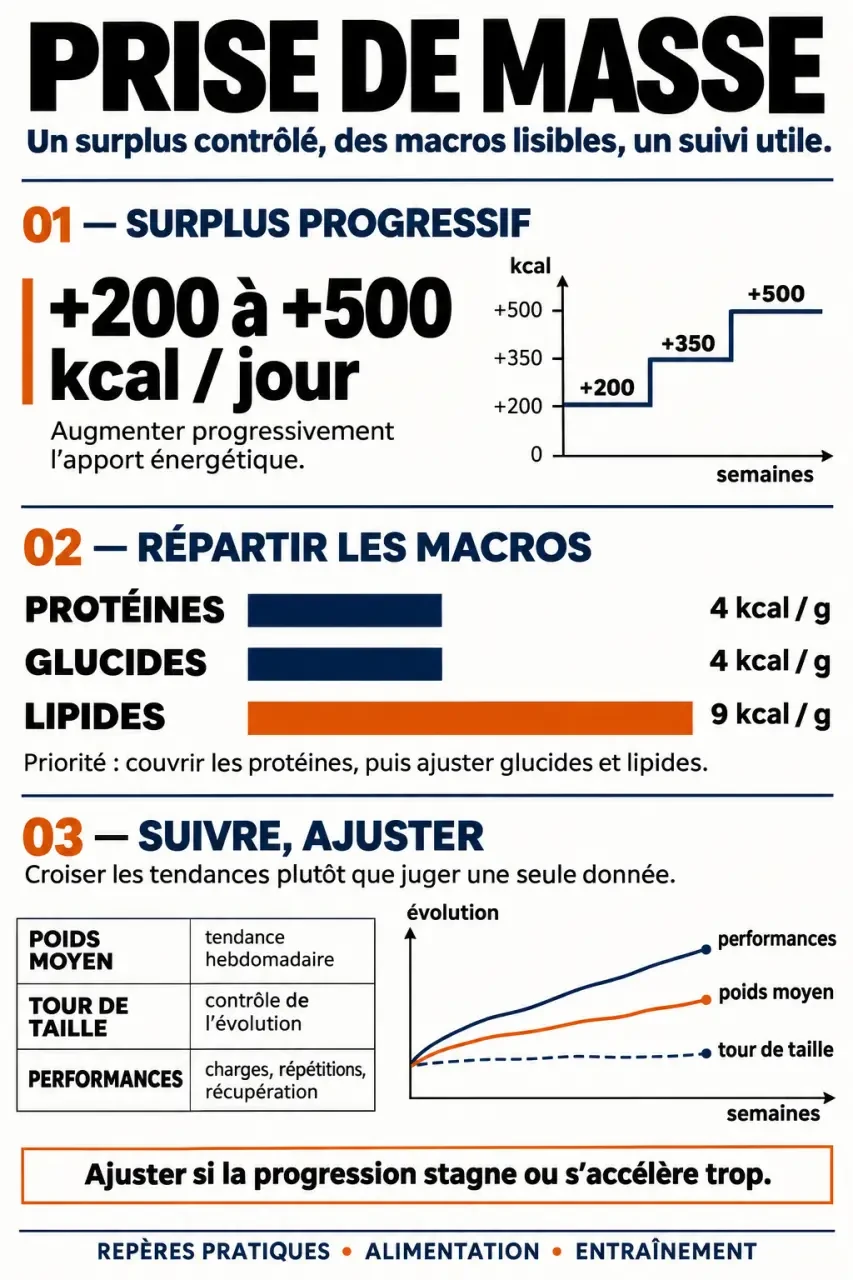
Then add 200 to 500 kcal per day above maintenance. Starting at the bottom of this fork usually helps to better control fat intake, especially if you already have experience in bodybuilding. For example, an observed hold at 2400 kcal gives a first target at 2,600 kcal with a surplus of 200 kcal.
Generic markers of 3,000 kcal for a man or 2,500 kcal for a woman are not a prescription. Similarly, the retention of 2,000 or 1,800 kcal by sex is not always accurate. Your actual evolution must guide the adjustments.
Divide proteins, carbohydrates and lipids without rigidity
Once the calorie intake is defined, divide it between the three macronutrients. Proteins contribute to muscle repair and construction, carbohydrates support effort, and lipids contribute to hormonal functioning and the absorption of certain vitamins.
| Nutrient | Practical benchmark | Useful foods |
|---|---|---|
| Proteins | 1.6 to 2.2 g/kg body weight per day | Eggs, fish, poultry, dairy products, tofu, legumes |
| Carbohydrates | 4 to 6 g/kg per day, to be adapted to the activity and calories concerned | Rice, pasta, oats, potatoes, bread, fruit |
| Lipids | A daily place, adjusted to the remaining calorie budget | Olive oil, nuts, seeds, fatty fish |
For a 75 kg person, this represents 120 to 165 g of protein and 300 to 450 g of carbohydrates per day. A 350 g carbohydrate intake is therefore within this range. However, these benchmarks should not lead you to exceed your energy target: especially adapt carbohydrates to your training volume.
To check your distribution, count 4 kcal per gram of protein or carbohydrate and 9 kcal per gram of lipid. For example, 140 g of protein, 350 g of carbohydrates and approximately 71 g of lipids represent nearly 2,600 kcal. This is an example of calculation, not a universal formula.
Prefer a variety of foods, mostly unprocessed, without banning pleasure foods. Fruit and vegetables remain essential for food balance. If the fibres satisfy you too quickly, alternate whole grains and starch easier to digest rather than suppress plants.
Compose an easy to repeat food day
An organization of 3 to 6 meals or food intakes per day allows to distribute the intakes according to your appetite. Six meals are not mandatory: three meals and one snack may suffice. Divide protein foods throughout the day rather than concentrate the essentials at dinner.
Here's an illustrative day for an adult exercising. Servings are a basis to adjust, not a menu that automatically matches your needs. The quantities of rice and pasta are indicated before cooking.
| Moment | Example of meals |
|---|---|
| Breakfast | 60 g oat flakes, 250 ml enriched soy milk or drink, one banana and 20 g nuts |
| Lunch | 100 g rice, 150 g chicken or a suitable serving of tofu, vegetables and a tablespoon of olive oil |
| Collation | 200 g of white cheese, 60 g of bread and fruit |
| Dinner | 100 g pasta, 150 g fish, vegetables and oil fillet |
For a vegetable version, combine tofu, tempeh, legumes, cereals and soy products, checking the total protein intake. Substitutions are not always equivalent at equal weight. For a small appetite, gradually add bread, oil or oil purée instead of disproportionate plates.
Around training, choose mainly digested meals. A snack combining carbohydrates and proteins can be convenient if the next meal is away, but no chronometer replaces daily regularity. Drink regularly, more when you sweat, without forcing yourself to absorb large amounts at once.
Track progress without confusing weight and muscle
A mass grab is usually built over several months: 3-6 months is a possible work horizon, not a mandatory duration. The 1 to 2 kg mark per month is not suitable for everyone: in an advanced practitioner, this rhythm can promote excessive fat intake. An initial increase also sometimes reflects more water and glycogen, not just muscle.
Consider your follow-up as a three-strand rope: medium weight, waist circumference and performance. One strand is not enough to interpret the progression. If the balance rises and the size increases without any improvement in training, the surplus deserves to be reviewed. If the loads increase with almost stable weight, do not mechanically add calories.
Take stock after about two weeks of regularity. If the average weight does not progress and recovery becomes difficult, slightly increase the portions. Conversely, reduce the surplus if the waist circumference increases rapidly. Avoid reacting to each isolated weighing.
On the strength side, 3 to 5 weekly sessions can be suitable depending on the level and recovery abilities. Essentials remains a progressive program, a controlled technique and sufficient sleep. Adding sessions despite persistent fatigue does not necessarily improve results.
Reserve complements to the needs actually identified
Whey can facilitate protein intake when meals are not enough. It is not essential if your diet already covers your needs. A gainer mainly brings calories: practical in some cases of low appetite, it can also quickly exceed the expected surplus.
Creatine can support performance during intense and repeated efforts, without replacing training. BCAAs generally have little additional interest when protein intake is sufficient. Before any purchase, examine the composition, traceability and practical utility of the product in your day.
In the event of kidney disease, treatment, pregnancy or eating disorders, ask for medical advice before making a major change in your diet or taking supplements. A dietician trained in sports nutrition can customize portions and follow-up. The best program is the one you can keep, digest and adjust calmly.
Updated on 10 November 2026