In case of back pain, it is best to temporarily set aside sports with contacts, jumps, heavy loads or fast rotations if they wake up the pain. This does not mean stopping any activity: walking, adapted bikes or movements in water often keep you active. The right choice depends mainly on your symptoms, your usual level and how your back reacts to exercise.
Contents
Sports to limit during painful push
Low back pain refers to pain in the lower back. It does not automatically mean that a disc is damaged or that a vertebrae is moved. During a painful episode, some stresses simply become less well tolerated: repeated impacts, accelerations, flexions or rotations under load.
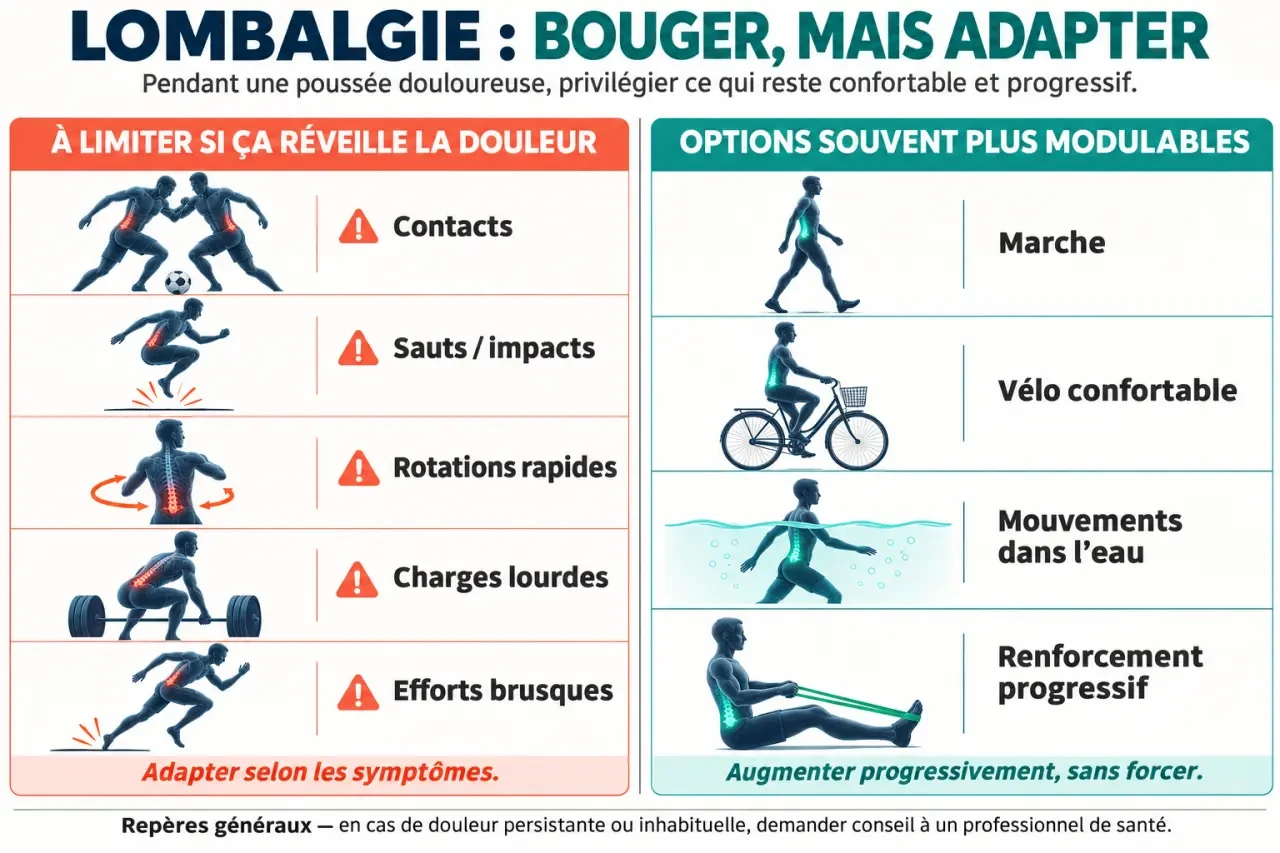
There is no list of life-prohibited sports for all people with low back pain. During a push, the aim is to suspend or modify actions that significantly aggravate symptoms, rather than consider the back to be fragile.
| Activities to be adapted or suspended | Requests sometimes poorly tolerated | Possible replacement |
|---|---|---|
| Rugby, combat sports, football with contacts | Unforeseen shocks, falls and movements | Contactless individual walking or training |
| Tennis, squash, golf | Rapid rotations and repeated explosive actions | Low-intensity technical gestures without painful movement |
| Fast racing, jumps, intense group sports | Impacts, Receptions and Change of Direction | Walking on regular terrain or comfortable bike |
| Heavy muscles, weightlifting | Efforts close to maximum and loaded movements difficult to control | Reduced loads and adapted exercises |
| Gymnastics, acrobatic movements | Large amplitude lumbar extensions or flexions | Soft mobility in a comfortable amplitude |
Running and bodybuilding are therefore not systematically discouraged. A trained person can sometimes pursue them by reducing load, speed or duration. On the other hand, starting an intense training while daily gestures are already difficult is rarely a good strategy.
Choose an alternative depending on what your back tolerates
Staying active helps maintain physical capacity and avoid deconditioning due to prolonged inactivity. Ameli places physical activity at the heart of the management of lumbago. The best sport is not necessarily the one known « good for the back », but the one you can practice regularly without lasting worsening.
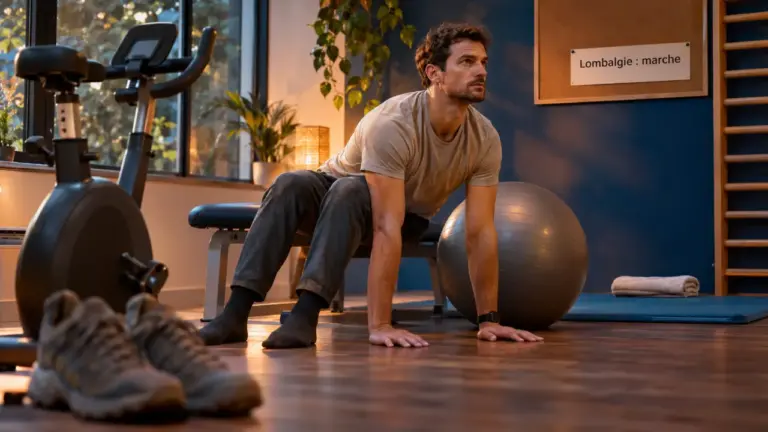
Walking and cycling to easily measure the effort
Walking is often the most accessible starting point: regular terrain, a comfortable look and the possibility of returning quickly. Several small outings can be better tolerated than a long walk. For the bike, prefer a comfortable position, without looking for a very lean posture. A flat bike facilitates the adjustment of the resistance; lower this if you have to get nervous to pedal.
Water, without imposing a particular swimming
Pelvis walking and gentle water movements can facilitate recovery. Swimming remains an option, provided you choose a controlled and comfortable swim. The bracing with the constantly raised head can accentuate the arch and hinder some people; Crawl can also become uncomfortable if breathing is poorly coordinated. No swimming therefore deserves a universal recommendation.
In a basin, think also of the current created by jets or other swimmers: it sometimes requires constant correction of its balance. If your back is irritable, start near a support, in a quiet area, rather than walking against the current. You can then increase water resistance gradually, as you would increase a load in the room.
Strengthening and tai-chi to regain ease
A progressive strengthening of the trunk, hips and legs helps to tolerate everyday efforts. The sheathing can be part of it, but holding a board for a long time despite the pain is not a goal. Tai Chi, with its slow and controlled movements, is another possibility. A physiotherapist can select variants compatible with your symptoms and favorite activities.
Adapt a session without monitoring each movement with concern
The pain depends on several factors: unusual effort, fatigue, insufficient recovery, stress or too rapid increase in training. A posture alone does not explain all the back pain. Above all, look for a comfortable movement and a load adapted to your current capacity.
- Warm up gradually: start with easy walking or gestures before more demanding movements.
- Change one parameter at a time: duration, speed, strength or amplitude, rather than all increase together.
- Keep margin: End the session before fatigue makes gestures difficult to master.
- Adjust the material: comfortable shoes, well-fitted saddle and suitable equipment, without waiting for an accessory to treat pain.
- Do not force stretching: they are optional and must remain comfortable, without seeking maximum amplitude.
Mild and stable discomfort does not necessarily mean injury. On the other hand, pain that gradually increases, alters your gait or further descends into the leg requires reducing or stopping exercise. Also observe your condition after the session and the next day: a net worsening indicates that the dose of effort was excessive.
For example, if a footing wakes up the pain, replace it with an tolerated walk rather than stay still all day. Then resume an easier version of your business, without immediately trying to regain your usual performance.
Persistent or unusual pain: when to seek advice
Compex states that 80% of adults face back pain. However, this frequency should not lead to the trivialization of all symptoms. The work councils mainly concern common back pain; pain after trauma or associated neurological signs requires a specific assessment.
The signs that warrant urgent consultation
A new difficulty in urination, loss of control of urine or stool, loss of sensitivity between the legs or a significant or progressive weakness of a leg require urgent medical assessment. Also stop sports and consult quickly in case of pain after severe trauma, associated fever or unexplained alteration of general condition.
Relieving without masking body signals
In the absence of a warning sign, temporarily reduce triggering forces while maintaining tolerated movements. Mild heat can bring relief, protecting the skin to avoid burns. If a medicine seems necessary, ask a healthcare professional for advice: taking an analgesic to force training is not a solution.
Check if pain worsens, persists without improvement, regularly returns or severely limits your daily life. The doctor may seek a cause requiring special care; The physiotherapist can accompany a graduation. The goal is not to permanently avoid sport, but to regain a bearable activity, and then progressive enough to last.
Updated on 17 November 2026